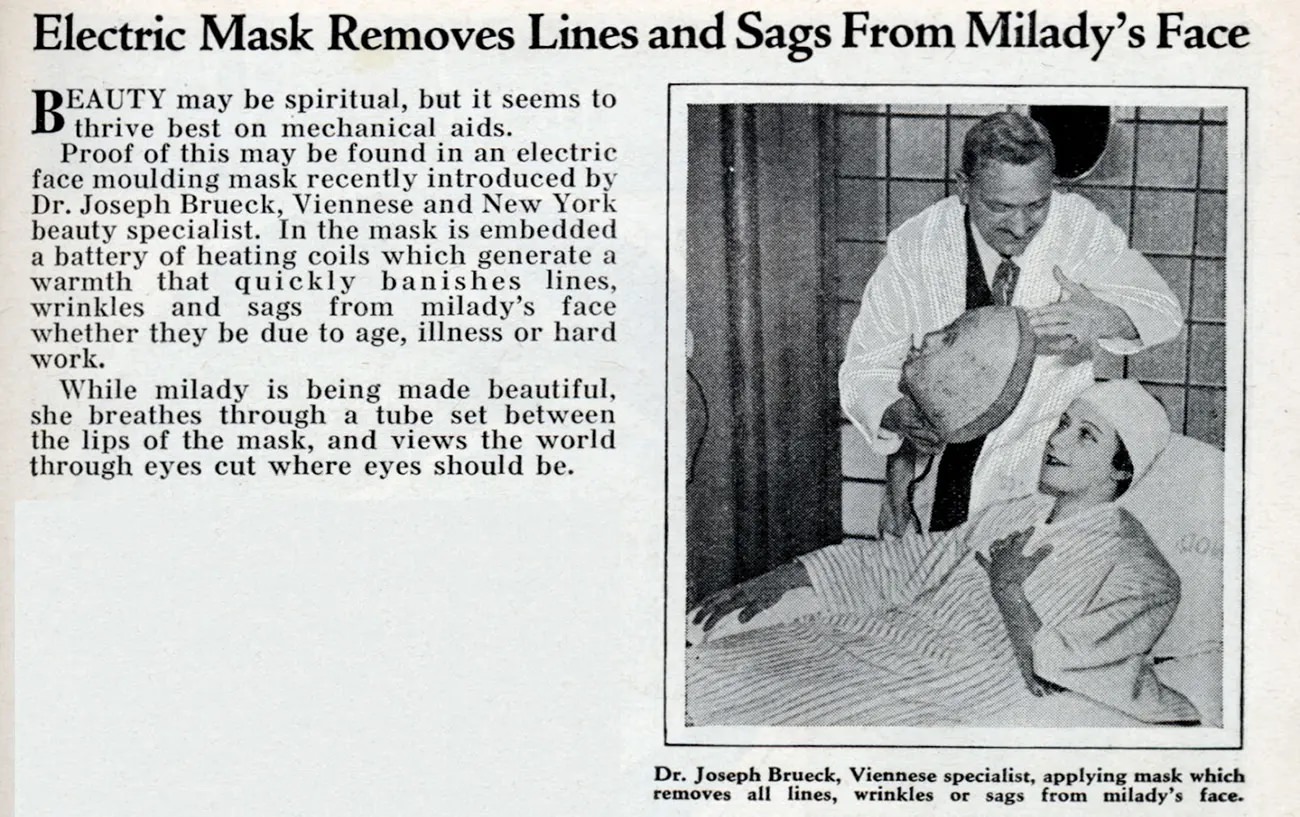
Promising to “remove lines and sags,” the electric mask in this striking old newspaper-style feature reads like a love letter to the machine age. The accompanying text frames beauty as something that can be engineered, describing a face-moulding device fitted with heating coils meant to deliver warmth and, supposedly, banish wrinkles. It’s a vivid reminder that modern anti-aging marketing has deep roots—and that the language of rejuvenation has long leaned on the authority of science and electricity.
In the photograph, a practitioner in a white coat holds the mask as a reclining woman looks on, the scene poised somewhere between clinic and salon. The apparatus appears rigid and enclosing, with cutouts for the eyes and a tube for breathing, emphasizing how experimental “beauty technology” could look (and feel) to its subjects. Even without a clear date or precise setting, the visual cues evoke an era when devices, treatments, and “specialists” promised transformation through equipment as much as through expertise.
Curiosity about weird exercise machines and workout methods from the past naturally overlaps with this kind of facial “training,” where improvement is presented as a mechanical process. For readers interested in vintage beauty gadgets, historical wellness trends, and the origins of cosmetic technology, the electric mask is a perfect artifact—half therapeutic contraption, half cultural mirror. It captures a moment when rejuvenating the face seemed as simple as plugging into progress, and when faith in modernity could be worn like a mask.