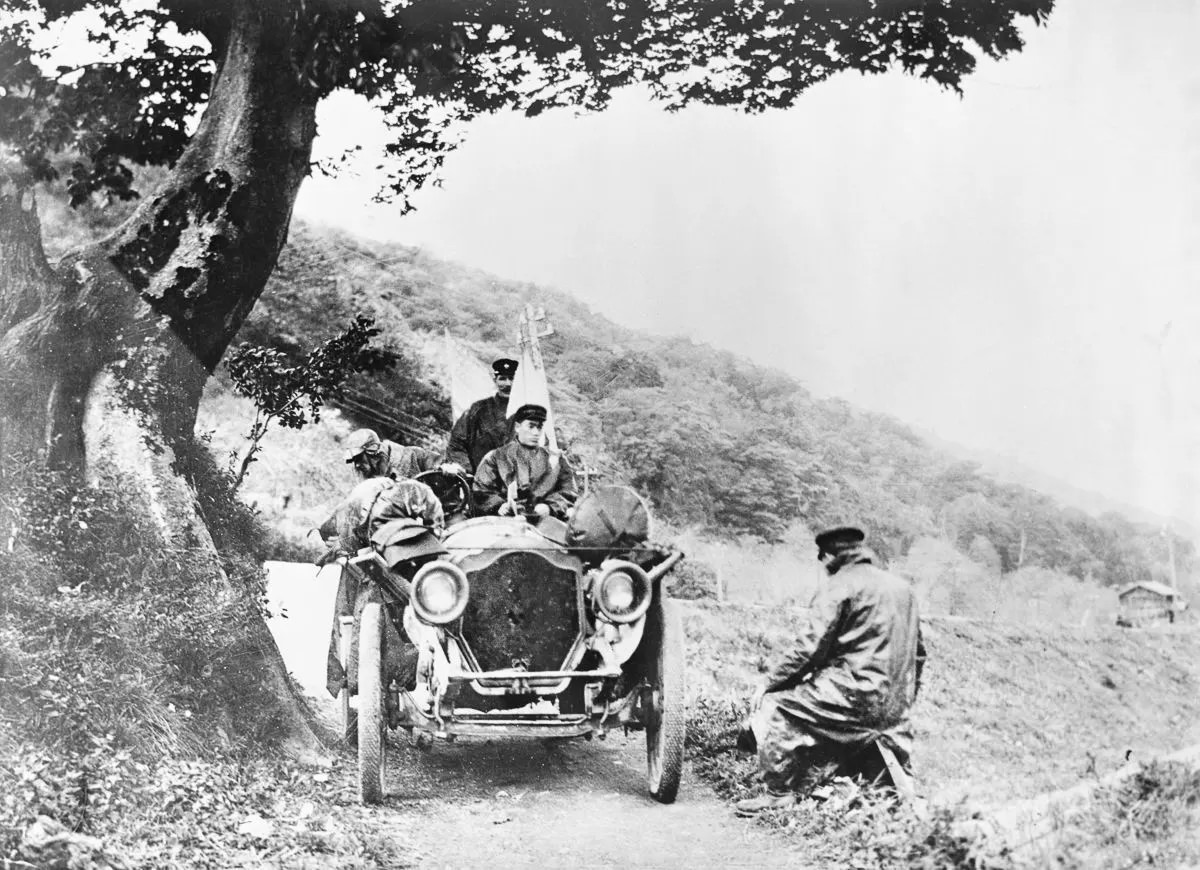
Beneath the spread of a roadside tree, the American Thomas Flyer pushes along a narrow track in the Manchurian countryside, its round headlamps and high wheels poised for ruts and mud. The car is burdened with the practical baggage of long-distance motoring—bundled gear and supplies strapped on, every inch of the machine pressed into service. Hills rise behind it in a soft haze, emphasizing how far this journey reaches beyond city streets and familiar roads.
Men cluster around the vehicle in heavy coats and caps, their attention fixed on the work of keeping an early automobile moving when “road conditions” could mean little more than a beaten path. One figure kneels at the verge as if scouting the ground or inspecting a wheel, while others ride high in the open cockpit, alert and braced. The scene conveys the improvisation that defined endurance driving in the early 1900s, when repairs, navigation, and sheer persistence were part of every mile.
As part of the wider story of the Great New York to Paris Auto Race, this moment in Manchuria captures the contrast between ambitious international sport and the stubborn realities of terrain. The Thomas Flyer’s passage through rural landscapes like this helped turn a mechanical novelty into a symbol of modern reach, proving that an American car could tackle distant country roads as readily as boulevards. For readers drawn to automotive history, early racing, and travel photography, the frame offers a vivid reminder that progress often advanced one rough track at a time.