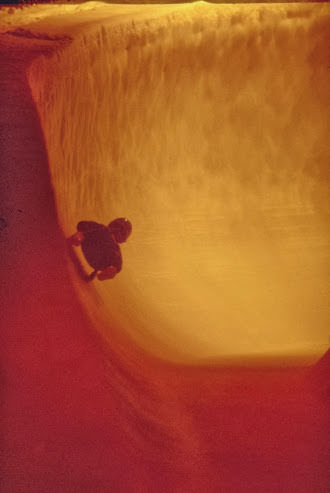
A steep, ice-carved wall fills the frame, bending like a frozen wave as a lone luger hugs the curve near the lower left. The warm, amber cast lends the scene an almost molten glow, heightening the contrast between the smooth chute and the athlete’s compact, aerodynamic posture. Even without close-up detail, the sense of speed is unmistakable—this is winter sport reduced to pure line, gravity, and nerve.
At the Sapporo Winter Olympics in 1972, women’s luge stood among the Games’ most demanding events, where fractions of a second were won by precision rather than brute force. The rider’s body is tucked tight, shoulders and helmet pressed into the track’s rhythm as the banking rises high overhead. That towering curve hints at the unforgiving engineering of Olympic luge runs, built to amplify momentum while leaving little margin for error.
Seen today, the photograph reads as both sports history and visual study, capturing how Olympic competition can look abstract from the right angle. It’s an evocative glimpse of women’s luge at Sapporo 1972—discipline, control, and velocity distilled into a single moment on the ice. For readers searching the history of the Winter Olympics, Japanese Olympic venues, or the evolution of women’s events, this image offers a memorable window into the era’s intensity.