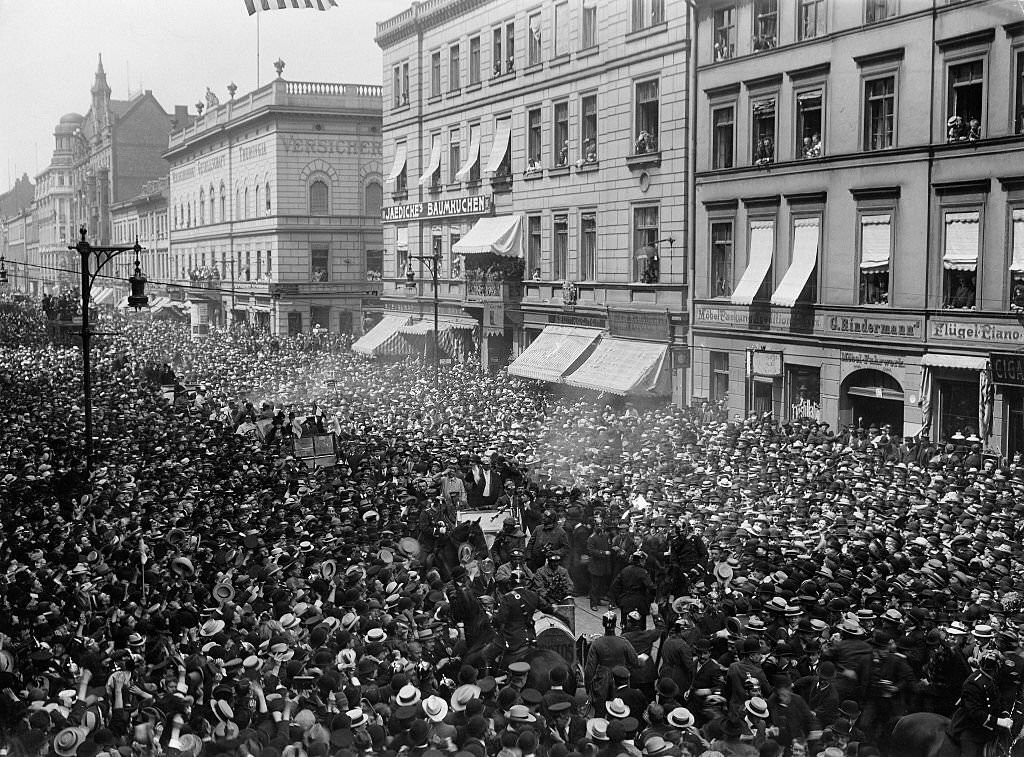
Berlin’s streets look barely able to contain the moment: a dense sea of hats and upturned faces fills the roadway, pressing in from shopfronts and balconies as the Protos car arrives to roaring acclaim. Store signs and striped awnings frame the scene, while onlookers lean from upper windows to catch a glimpse of the machine that has become the day’s main character. The crowd’s sheer scale hints at how motor racing, still young in 1908, could already seize a city’s imagination like a public festival.
At the heart of the excitement lies the legendary New York to Paris auto race, a marathon that stretched on for more than seven months and turned endurance driving into global news. The Protos team’s entry into Berlin reads like a victory lap within the broader journey—part sporting feat, part demonstration of modern engineering pushing beyond familiar roads. In an era when long-distance travel still carried an aura of uncertainty, this arrival becomes a snapshot of confidence in technology and the people bold enough to test it.
What makes this historic photo so compelling is its layered detail: the tight corridor carved through the crowd, the uniformed figures attempting to hold a line, and the architecture that anchors the spectacle in everyday urban life. For readers searching for the Great New York to Paris Auto Race of 1908, early motorsport history, or Berlin’s turn-of-the-century street scenes, the image offers an immediate, human-scale view of a world gathering around speed, progress, and shared astonishment. It’s not just a racing story—it’s a portrait of a city momentarily united by the arrival of a rumbling, road-worn icon.