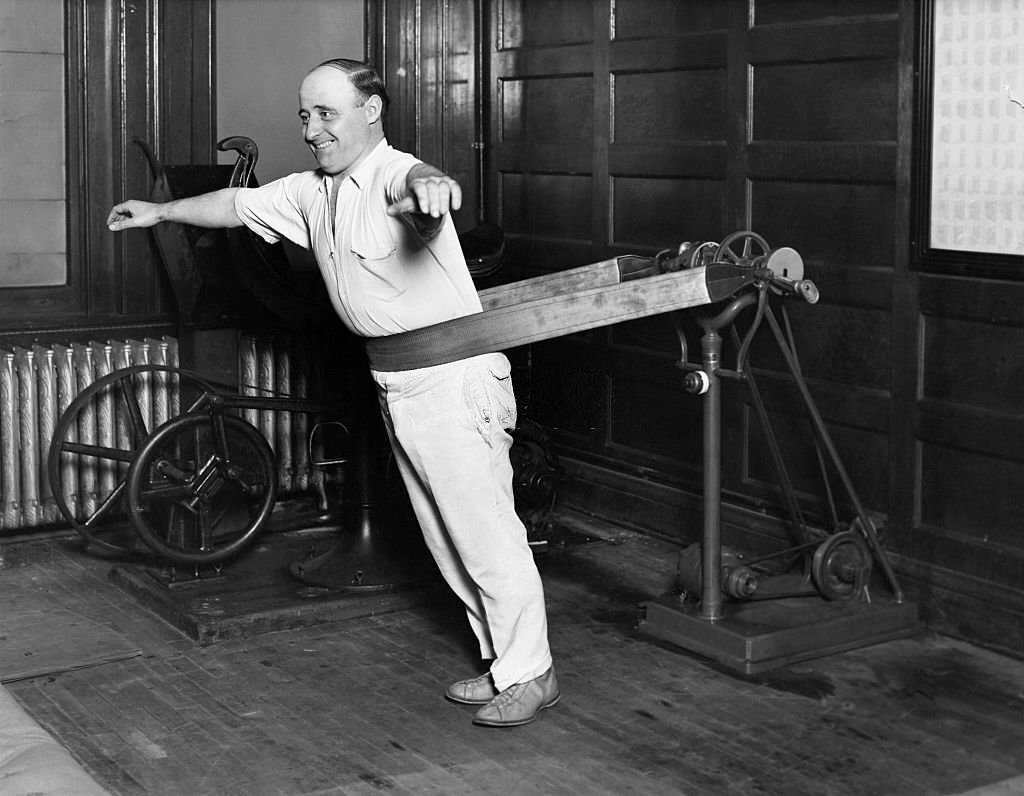
A smiling office worker leans into a curious contraption: a wide belt cinched around his waist and arms held straight as the machine’s rigid beam draws him forward. Behind him, the room looks more like a paneled workplace than a gym, with a radiator, tall window, and heavy woodwork framing the scene. The apparatus itself—part belt sander, part mechanical trainer—sits low and sturdy, its wheels and pulleys hinting at a faith in engineered motion to keep a sedentary body “fit.”
Chicago’s business and professional men, the title tells us, embraced this daily exercise machine in imitation of the routine associated with President Coolidge. That detail matters, because early fitness culture often sold health through authority: if a president used it, the thinking went, it must be modern, safe, and effective. In an era when desk jobs expanded and “nervous strain” was a common worry, devices like this promised efficient, no-nonsense movement without the mess of athletics—or the time required for long workouts.
For readers interested in weird exercise machines and workout methods from the past, the photo is a vivid reminder that today’s fitness trends have deep roots in mechanical optimism. The belt-driven pull, the formal indoor setting, and the subject’s confident posture all point to a moment when technology and self-improvement were marketed as the same project. It’s an odd, fascinating snapshot of American exercise history—where professionalism, prestige, and physical culture met in one whirring machine.