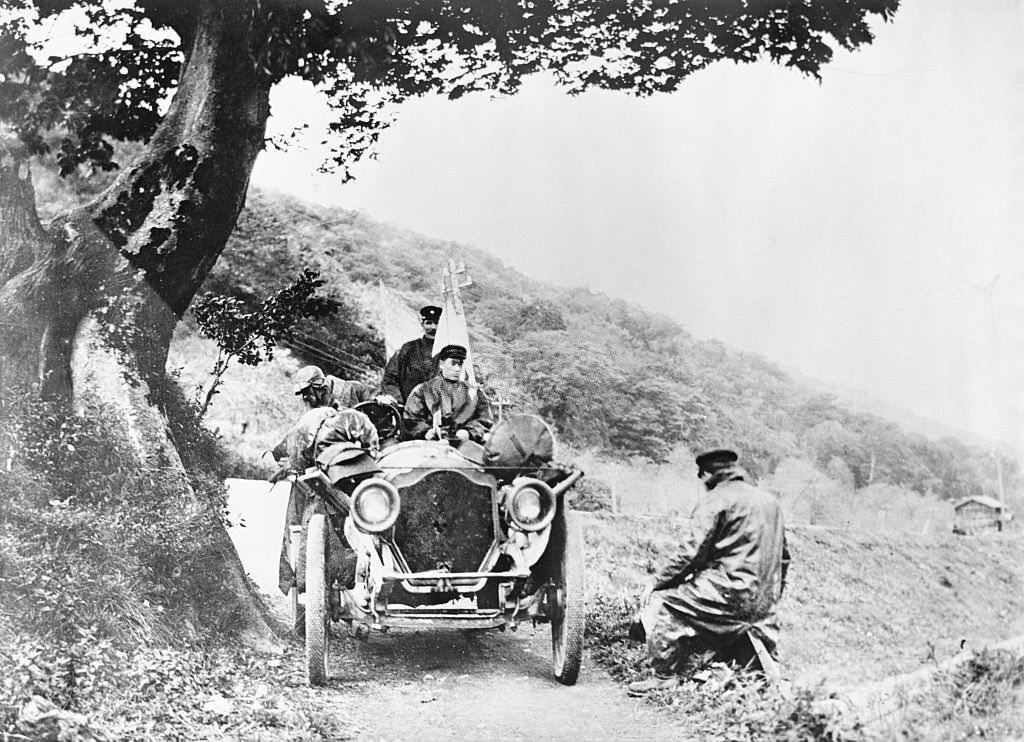
Beneath a spreading tree on a narrow, rutted track, the Thomas Flyer pushes forward with its crew perched high and watchful, the car’s round headlamps and tall wheels dominating the foreground. A figure crouches at the roadside as if studying the strange machine passing through a quiet rural landscape, while hills rise in the misty distance. The scene has the feel of a brief pause in motion—an improvised roadside moment during one of motoring’s most audacious endurance challenges.
As the American entry in the 1908 New York to Paris Auto Race, the Thomas Flyer carried not only supplies and spare gear but the burden of proving that an automobile could cross continents where proper roads barely existed. In Manchuria, every mile demanded navigation, mechanical ingenuity, and stamina, with locals, guides, and onlookers becoming part of the story as the racers threaded through villages and mountain passes. The composition underscores the scale mismatch between early cars and the landscapes they attempted to conquer, turning an ordinary path into a proving ground for modern travel.
Motor racing history often focuses on speed, yet this photograph speaks more to perseverance—mud, distance, and uncertainty instead of grandstands and trophies. For readers searching the Great New York to Paris Auto Race, the Thomas Flyer, or early automotive exploration in Asia, it offers a vivid window into how global competition intersected with everyday life along the route. Here, innovation arrives not as a polished spectacle, but as a noisy, fragile vehicle edging forward into the unknown.