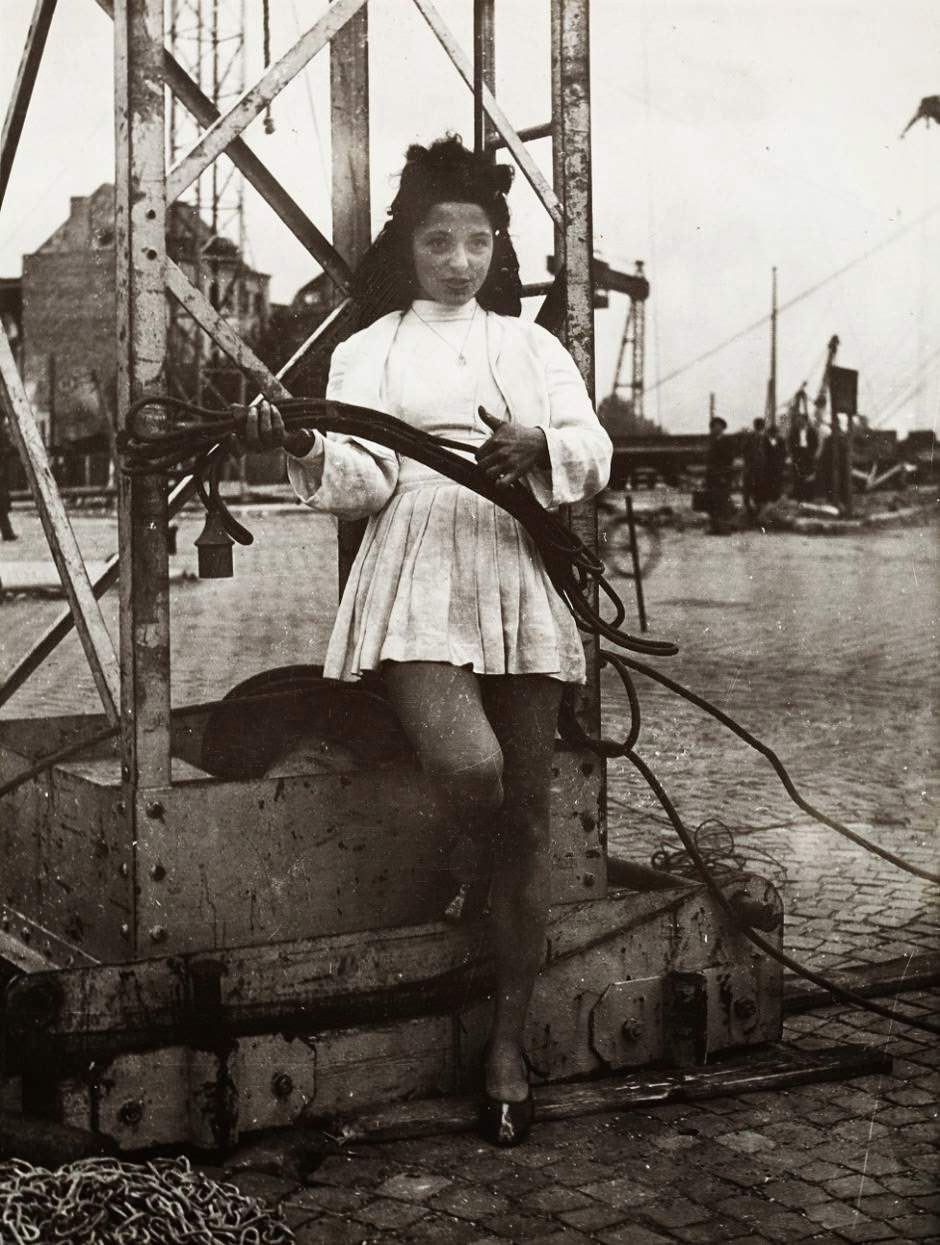
Poised beside a lattice of rigging, a young high-wire performer in a light costume holds a thick coil of rope as if it were just another prop in the act. Her steady gaze and relaxed posture suggest the practiced confidence behind circus artistry, where strength, balance, and nerves are trained like any sport. The cobbled ground and heavy metal framework anchor the scene in the practical world of setup and safety, moments before spectacle takes over.
Heumarkt in Cologne becomes more than a backdrop here; it reads as an open-air stage where everyday life and entertainment briefly intersect. In the distance, figures and equipment gather around the performance area, while damaged or unfinished structures hint at a city still rebuilding its routines in 1946. The contrast between the performer’s crisp outfit and the industrial scaffolding underscores how improvisation and resilience shaped public events in the immediate postwar period.
A Balancing Act captures the hidden labor of a high-wire show as much as the thrill, making it a compelling historical photo for readers interested in circus history, Cologne’s urban past, and postwar German sports and culture. Details like the ropes, chains, and portable platform point to the technical side of performance—tension, grip, and precision—long before the crowd looks up. Seen today, the image preserves a fleeting moment when daring entertainment offered a breath of normality and wonder in a hard-won public space.