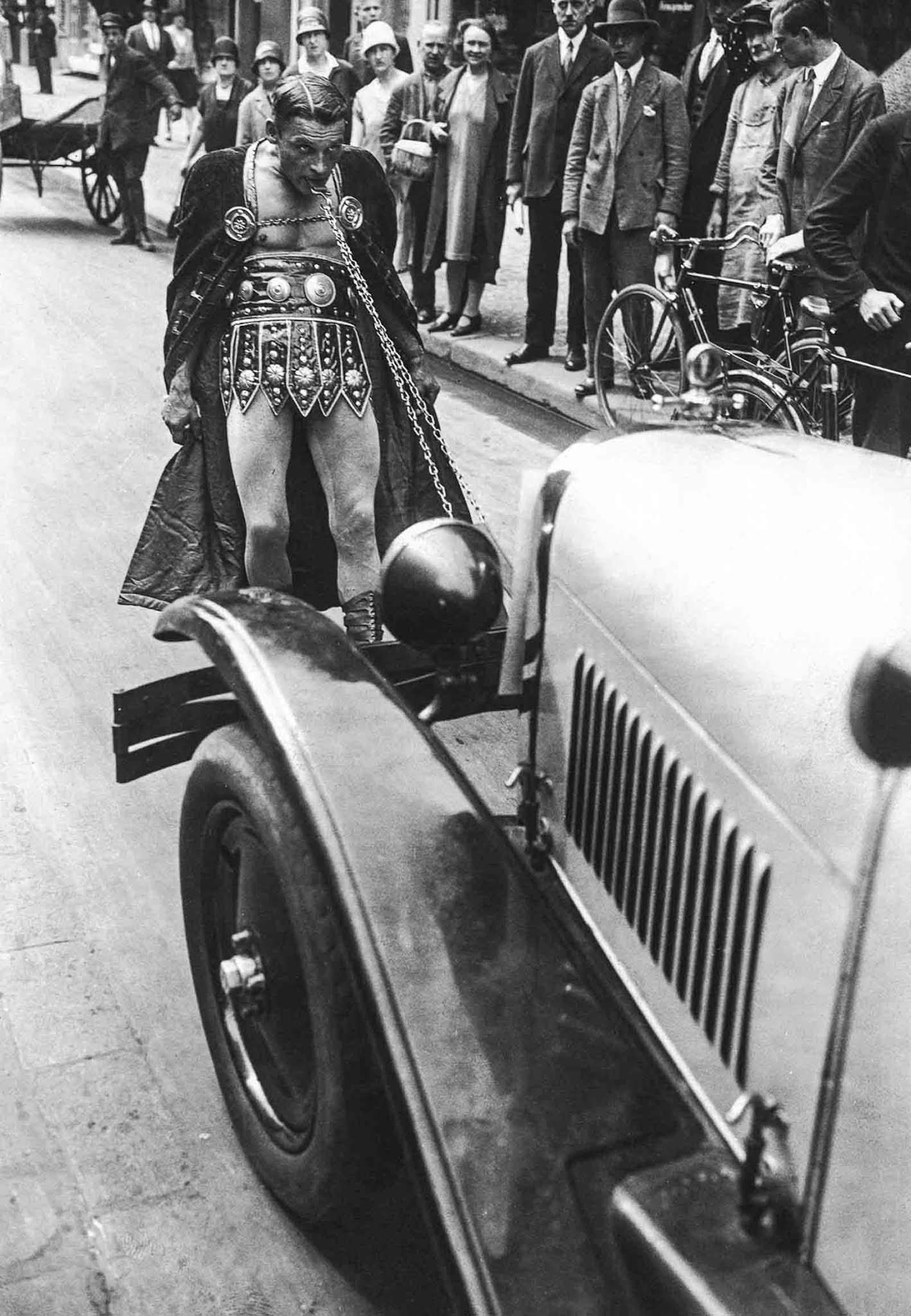
Stefan leans forward with a chain clenched between his teeth, body braced and eyes fixed on the strain ahead as a motorcar looms in the foreground. His showman’s costume—part cape, part armor-like belt—turns raw exertion into street theater, while the car’s fender and grille underscore the sheer weight he is about to move. Around him, pedestrians gather close, forming an impromptu audience for one of the era’s most jaw-dropping strongman stunts.
Berlin in 1925 was a city of modern machinery and mass spectacle, and this public demonstration sits right at that intersection. The presence of bicycles, suits, and hats in the crowd hints at everyday life stopping briefly to witness extraordinary physical culture, the kind promoted by circuses and vaudeville acts across Europe. Towing a vehicle with the teeth was not merely a trick; it was a carefully staged test of endurance, pain tolerance, and image-making that relied on both strength and nerve.
What lingers in this historical photo is the mix of disbelief and fascination—onlookers edging in, faces intent, as entertainment spills into the street. For readers interested in early 20th-century sports history, circus strongmen, and the culture of feats of strength, Stefan’s motorcar tow offers a vivid snapshot of how performers marketed themselves before television and viral media. It’s a reminder that long before modern fitness influencers, the strongman tradition thrived on dramatic proof, public crowds, and the unmistakable clang of a chain under tension.