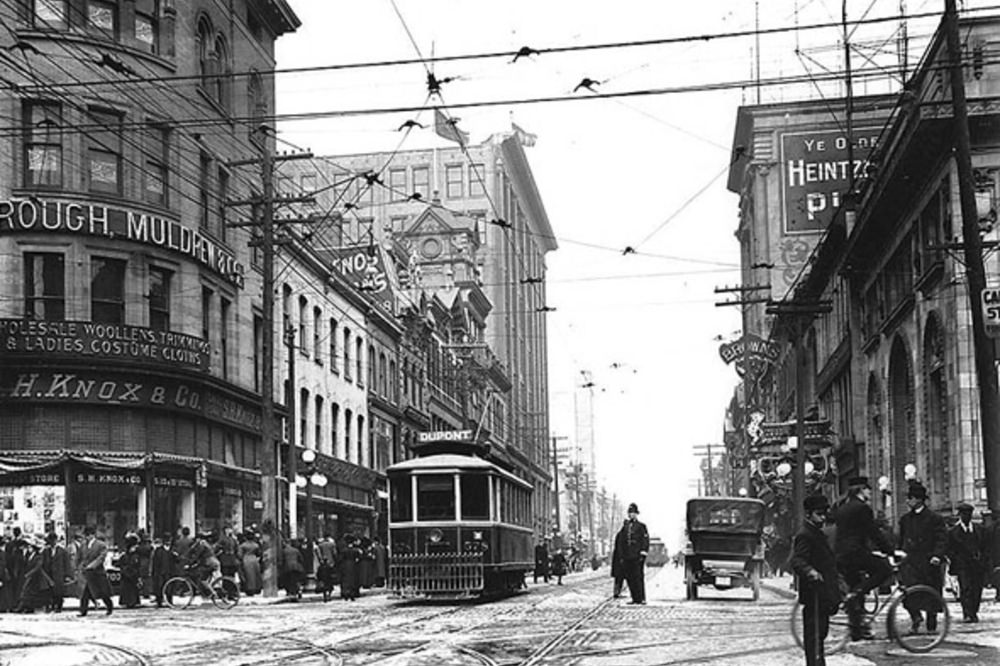
Streetcar wires crisscross the sky above Queen & Yonge, turning the intersection into a web of modern movement as storefronts and signage press in on both sides. A streetcar sits on the tracks while pedestrians gather along the sidewalks, and the road surface—scarred by rails and traffic—hints at the daily grind of a growing city. In the middle distance, vehicles and people negotiate space in a streetscape built for many kinds of motion at once.
Near the right edge of the frame, cyclists hover like an afterthought, partly obscured by the crowd and the curbside bustle. That placement says a lot: bicycles are present, practical, and clearly part of Toronto’s street life, yet they’re still squeezed into the margins beside larger vehicles and foot traffic. The scene captures a moment when cycling was woven into everyday commuting and errands, not set apart as recreation alone.
Early-1900s Toronto street photography like this offers more than nostalgia—it documents how infrastructure, commerce, and personal mobility collided at one of the city’s busiest crossroads. Queen and Yonge reads as a marketplace of movement, where streetcars, pedestrians, and cyclists all share the same uncertain right-of-way. For readers interested in cycling history in Toronto, this 1910 view is a vivid reminder that the debate over space on the street is far older than the bike lane era.