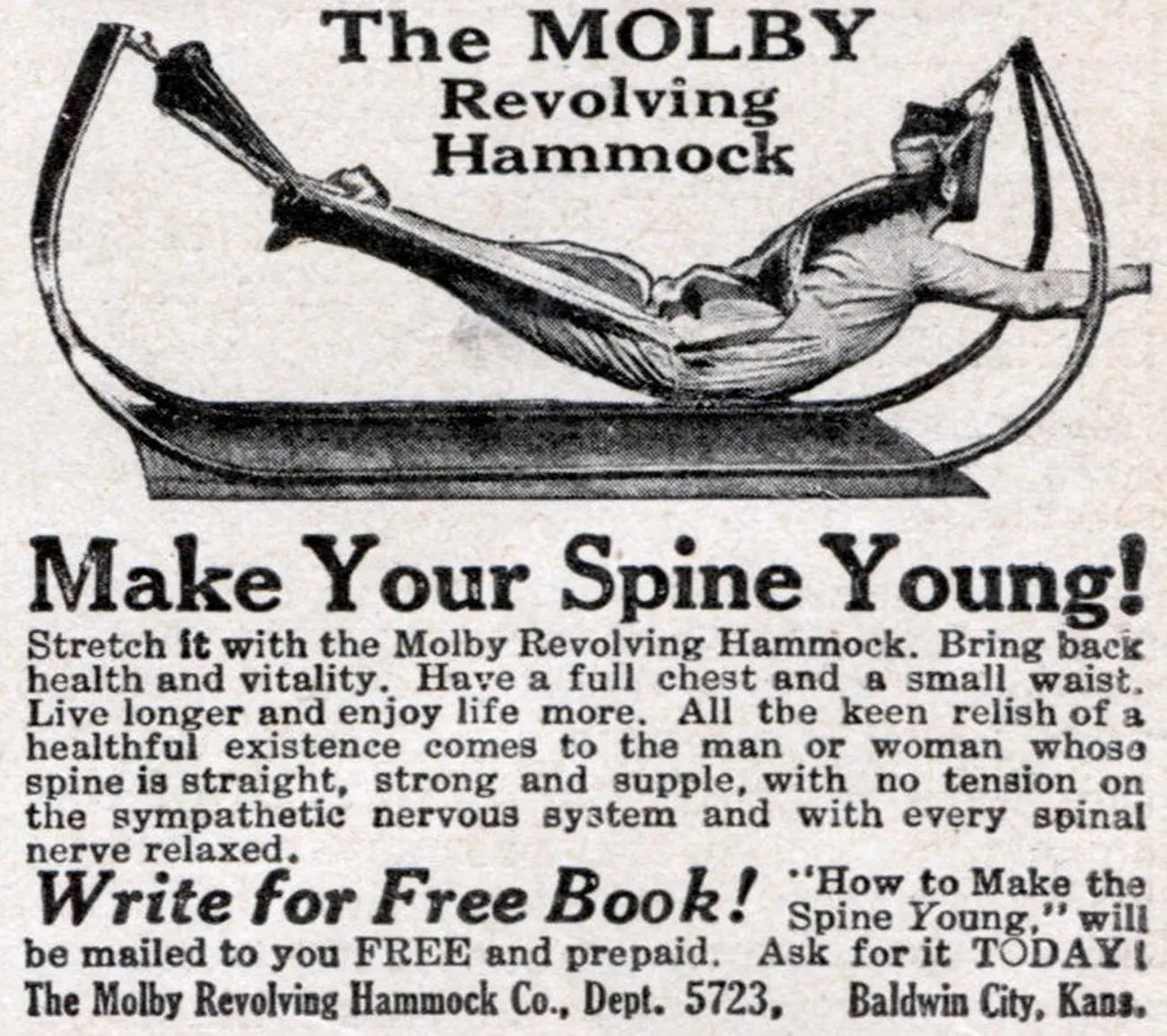
Bold lettering promises “Make Your Spine Young!” while an illustrated figure reclines in the Molby Revolving Hammock, suspended within a large curved frame that looks part cradle, part gym apparatus. The design suggests a controlled rocking or rotating motion meant to stretch the body from shoulders to ankles, blending relaxation with the era’s fascination for mechanical fitness. Even at a glance, it reads like an advertisement engineered to turn everyday aches into a solvable problem—if only you buy the right device.
What makes the Molby Revolving Hammock so memorable is the sales pitch wrapped around posture and vitality: a straight, strong, supple spine is offered as the gateway to renewed health, a fuller chest, and a trimmer waist. The copy leans into the language of nerves and “tension,” reflecting an age when modern life was often blamed for bodily strain and when home exercise contraptions promised scientific relief. It’s a striking example of how sports culture and wellness marketing overlapped, selling self-improvement through ingenuity and a bit of spectacle.
Down at the bottom, the ad invites readers to “Write for Free Book!” and includes the company line and address—The Molby Revolving Hammock Co., Dept. 5723, Baldwin City, Kans.—a reminder of how these products traveled by mail and by persuasion. For anyone interested in weird exercise machines and workout methods from the past, this piece offers both the gadget and the dream attached to it: effortless fitness, restored youth, and a better life by way of a revolving hammock. Seen today, it’s equal parts curiosity, cautionary tale, and a window into the long history of spine care and home fitness fads.