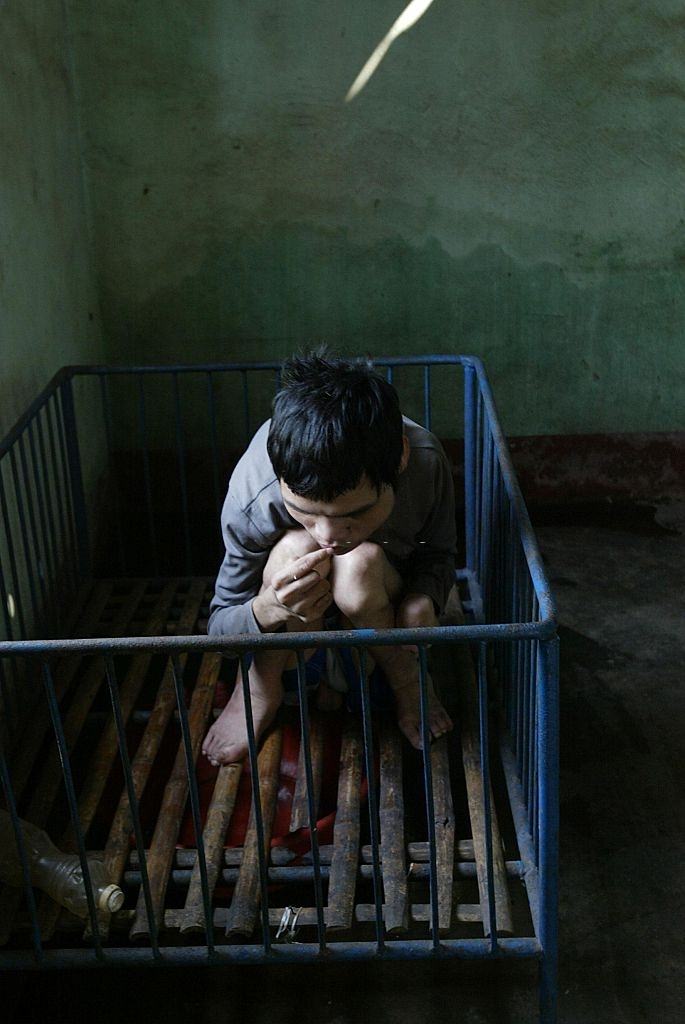
In a dim room with peeling green walls, Truong Tan Thong crouches inside a metal playpen, his body folded inward as if trying to make himself smaller than the space that contains him. The bars cast a hard geometry across the scene, while a slatted floor and scattered objects near the corner hint at the daily improvisations of care. Even without motion, the photograph carries a heavy stillness—an adult trapped in a setting meant for infancy.
The title frames Thong as a 25-year-old soldier’s son and a victim of the Agent Orange legacy, pulling the Vietnam War out of the past and into the intimate scale of one life. Rather than battlefields or uniforms, the aftermath appears here as confinement, dependency, and the quiet endurance of a family living with long-term disability. That contrast is what makes the image so unsettling: history’s grand narratives compress into a single room, a single enclosure, and a single human figure.
For readers searching for Vietnam War history, Agent Orange consequences, or the intergenerational impact of chemical exposure, this photo offers a stark, humane entry point. It asks us to consider what “postwar” means when the costs are carried for decades, often beyond public view. Seen today, the image becomes both documentation and plea—a reminder that the legacy of conflict can persist in ordinary homes, long after the fighting ends.