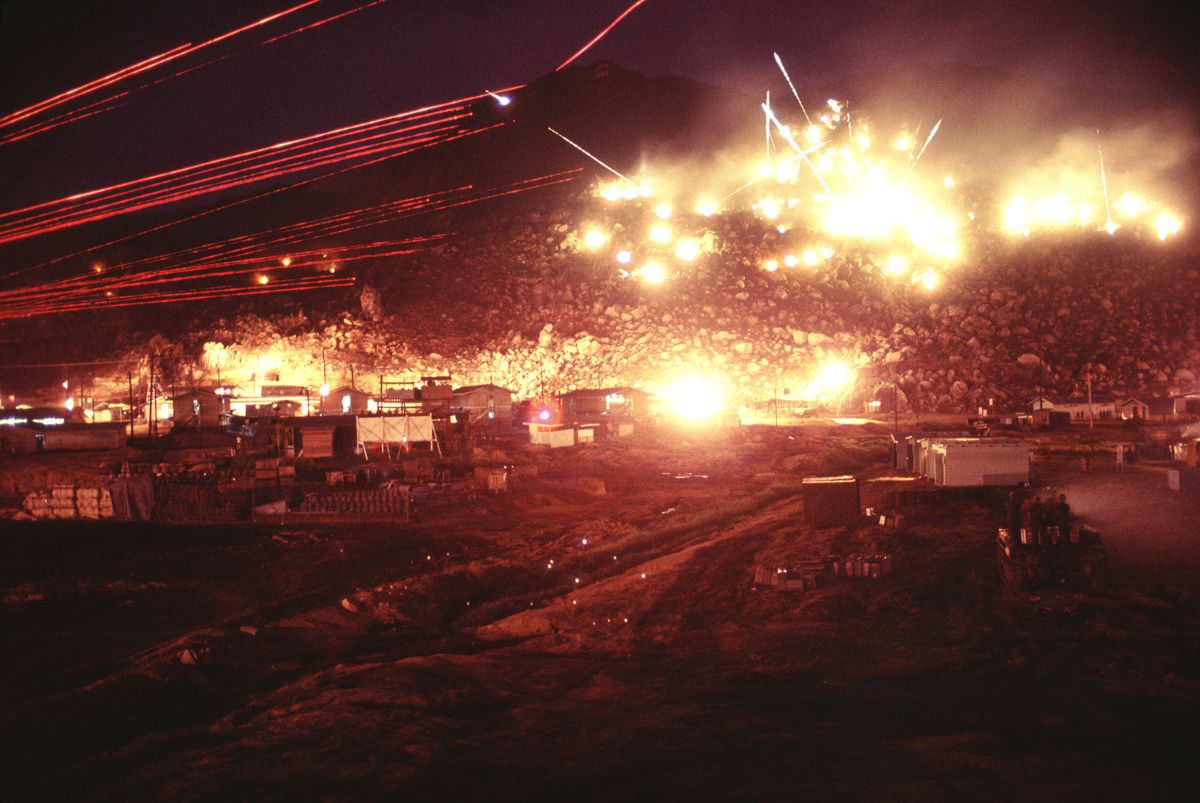
Night turns the hillside into a harsh stage of fire and motion as hand-launched flares bloom overhead, bleaching the slopes in sudden, wavering light. Red tracer lines streak across the frame from M60 machine-gun bursts, carving luminous paths that make the terrain’s ridges and rock faces briefly legible. Near the mountain’s upper edge, a bright ricochet punctuates the chaos, a reminder of how unpredictable gunfire could be in the dark.
In the Vietnam War, illumination and suppression often went hand in hand, and the photograph conveys that tactical rhythm without needing close-up faces. Flares hang and drift, buying seconds of visibility; tracers mark arcs of fire, guiding gunners and signaling positions while also exposing them. The scattered lights below suggest a fortified area or base-like compound, small structures dwarfed by the looming hillside and the violence unfolding above it.
For readers searching Vietnam War photography, combat at night, or M60 machine gun tracer fire, this scene distills the era’s visual language into one intense moment. The long-exposure glow and saturated reds and yellows turn battlefield mechanics—flares, tracers, impacts—into a stark, almost elemental landscape. It’s a powerful historical image of how technology, terrain, and darkness shaped survival and decision-making under fire.