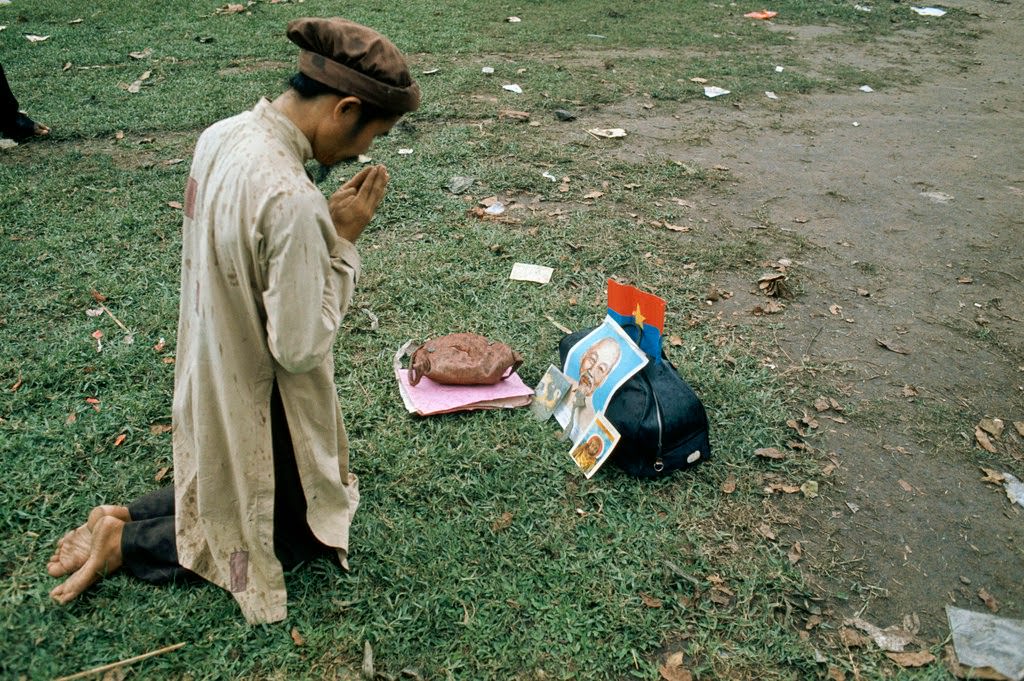
Kneeling on a patch of grass with hands pressed together, a Vietnamese man turns his full attention toward a small, improvised shrine: a portrait of Ho Chi Minh propped against a dark bag, flanked by a few paper items and a folded cloth. The simplicity of the scene—no altar, no crowd, only the posture of prayer—draws the eye to the quiet intensity of the moment, where personal faith and political symbolism meet in the open air.
Set in the aftermath of the Fall of Saigon, the photograph speaks to the Vietnam War’s abrupt end and the uneasy beginning of a reunified nation. Public space becomes a stage for private devotion, and the portrait functions as both icon and message, suggesting a shifting landscape in which allegiance, survival, and belief could be expressed in small gestures rather than grand declarations.
Details on the ground—scattered litter, worn earth, and the modest belongings gathered beside the portrait—hint at instability and transition, the everyday texture of life after conflict. For readers searching Vietnam War history, post-war Vietnam, or images of Ho Chi Minh and revolutionary symbolism, this frame offers a human-scale entry point: one man, one prayer, and a country redefining itself in real time.