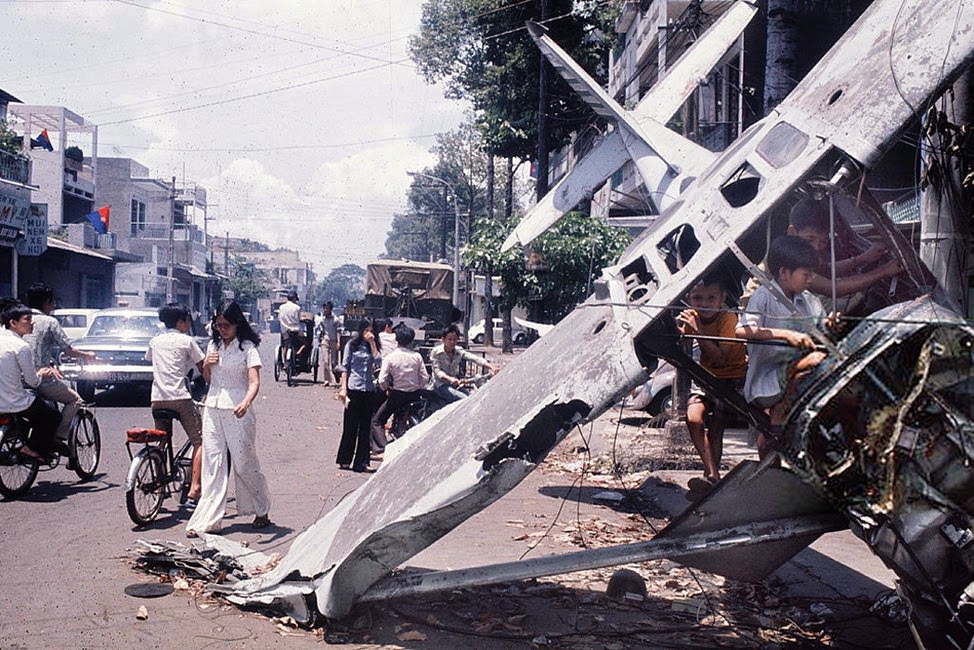
Twisted aircraft wreckage lies sprawled across a Saigon street on April 30, 1975, its torn fuselage and clipped wings turning an ordinary block into an obstacle course of metal and splintered parts. The plane’s body leans into the curb and nearby buildings, wires and debris scattered along the roadway. In the same frame, everyday traffic continues—bicycles rolling past, a car easing along, pedestrians threading their way around the ruin—underscoring how quickly wartime danger and daily routine collided in the city’s final hours.
Children and adults gather close to the wreck, some peering into the broken shell as if trying to make sense of what fell from the sky and why it landed here. The street scene feels unsettlingly calm: people pause, point, and move on, while the aircraft’s jagged edges and exposed interior speak of sudden violence. That tension between curiosity and caution captures a defining texture of the Vietnam War’s endgame, when neighborhoods could become front lines without warning.
Saigon’s fall is often summarized through evacuation images and sweeping political headlines, but ground-level photographs like this preserve the intimate geography of collapse—one street, one wreck, many witnesses. The picture offers a stark, SEO-relevant window into the Fall of Saigon, the Vietnam War’s closing moments, and the civilian cityscape caught in transition. Viewed today, the wrecked airplane becomes both artifact and metaphor: a machine of war reduced to scrap, while life, stubborn and immediate, keeps moving around it.