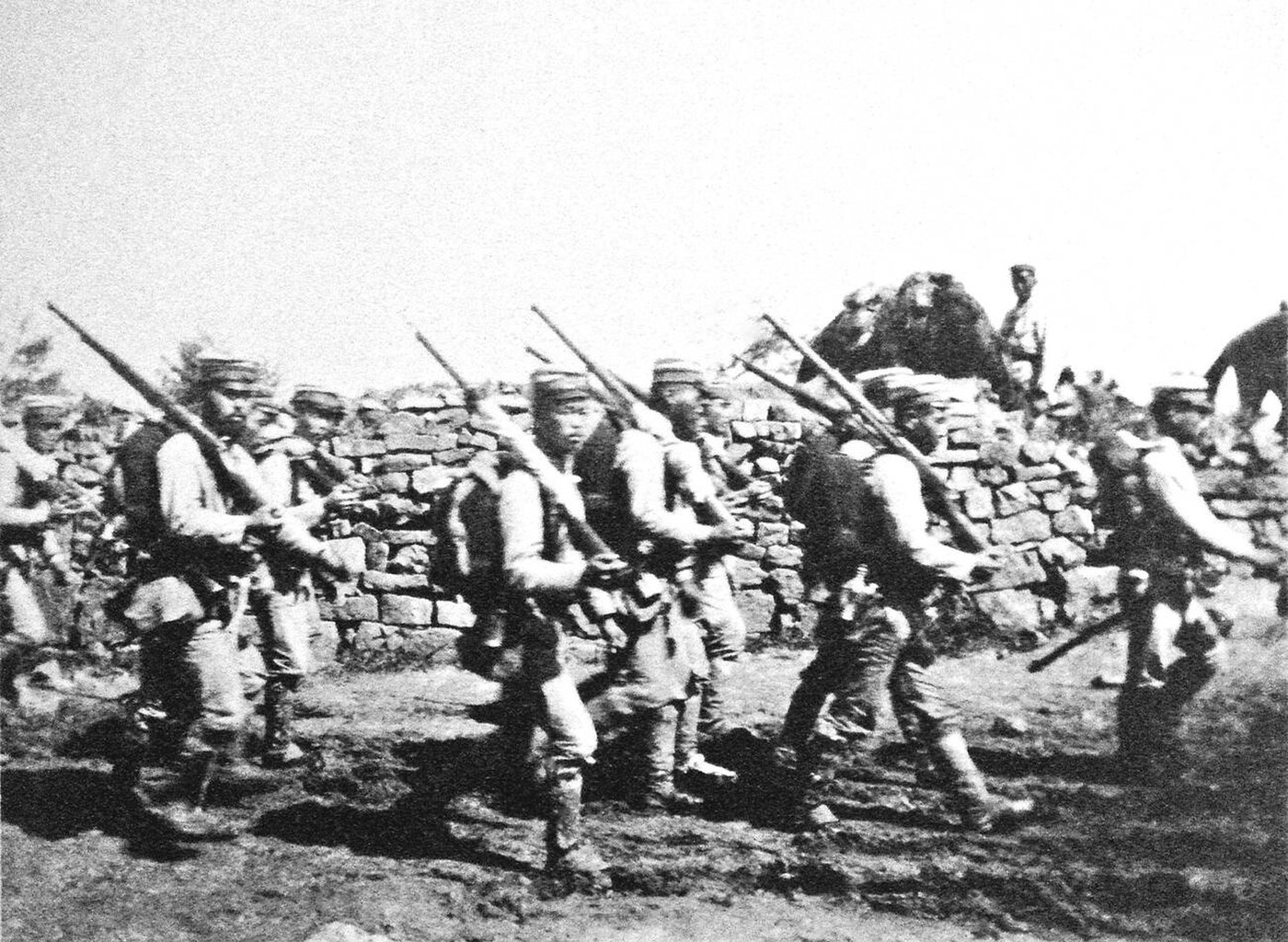
Marching in a tight file with rifles shouldered, Japanese soldiers move past a low stone wall near Chemulpo (modern Incheon) during the Russo-Japanese War in 1904. The grainy texture and slight blur hint at a quickly captured moment, more field record than studio pose, where packs, caps, and uniforms form repeating patterns across the frame. Even without dramatic explosions or banners, the scene carries the unmistakable weight of mobilization and direction, a column advancing with purpose.
Chemulpo mattered because ports and roads were lifelines, and control of approaches on the Korean peninsula shaped how forces could land, supply, and maneuver. The wall behind the men—rough stones stacked into a boundary—suggests a landscape of villages and farmland caught beside military movement, a reminder that wars are often fought across everyday terrain. For readers interested in Russo-Japanese War history, early twentieth-century military logistics, or Japan’s campaign operations in Korea, this photograph offers a grounded, human-scale view.
Details reward a closer look: the forward lean of strides, the set of shoulders under heavy kit, and the way the line compresses as it passes the camera’s position. Weapons and gear dominate the composition, yet individual faces briefly emerge before dissolving back into the marching mass, capturing the tension between personal experience and the machinery of war. As a piece of wars-and-military imagery, it serves both as a visual document and as an entry point into the larger story of conflict, empire, and contested space in East Asia.