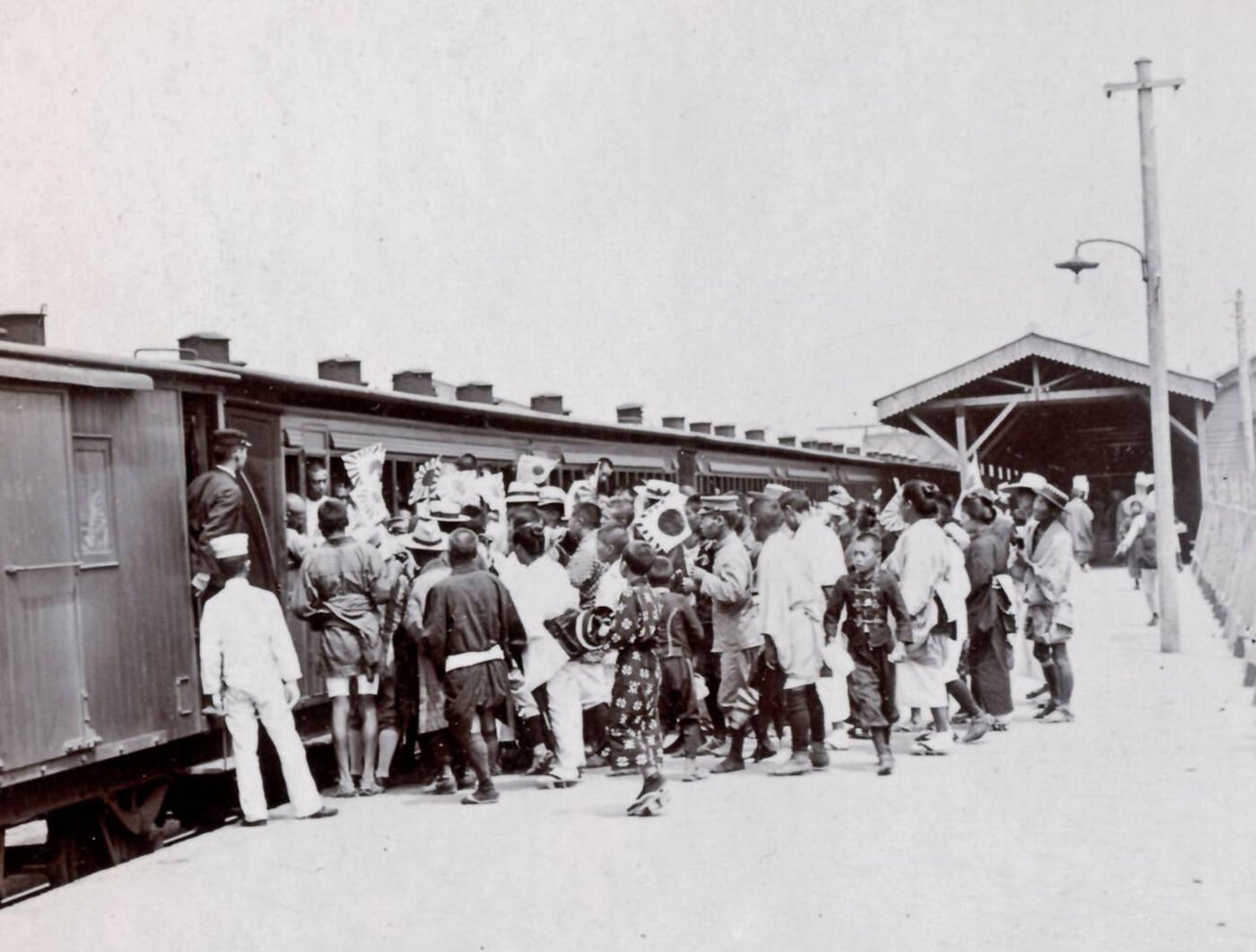
A busy railway platform becomes a stage for farewells as a packed crowd presses up to the side of a passenger train, faces turned toward the open doors and windows. Uniformed men and civilians mingle at close quarters, with hats, bundles, and raised hands creating a restless pattern against the long line of carriages. The station canopy and tall lamp posts frame the moment, emphasizing the modern machinery of travel that carried young soldiers from home toward distant battlefields.
During the Russo-Japanese War of the 1900s, departures like this stitched the front line to everyday life, turning stations into emotional crossroads. Parents, relatives, and friends appear to exchange last words and hurried gestures, the kind of intimate contact that photographs of wars and military history often struggle to convey. The scene hints at community involvement—supportive, anxious, proud—while the train waits, solid and impersonal, ready to pull away.
Viewed today, the photo offers more than a record of troop movement; it preserves the social texture of an era when mass mobilization met rapid transportation. Clothing details and body language underline the contrast between civilian routines and military duty, all compressed into a few crowded minutes beside the tracks. For readers exploring early 20th-century wartime photography, this departure tableau captures the human cost of conflict at the very moment it begins—on the platform, before the journey vanishes down the line.