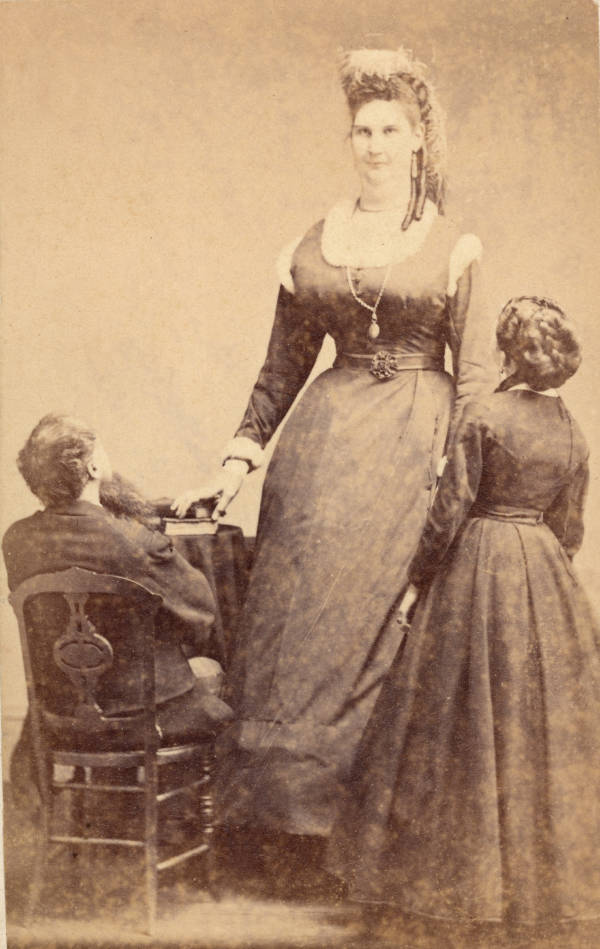
Between the seated father and the standing mother, Anna Haining Swan Bates rises like a living monument, her height turning an ordinary studio portrait into a striking statement about scale and spectacle. The plain backdrop and careful posing keep the focus on relationships and proportions, inviting the viewer to measure the extraordinary against the everyday. Even without the noise of a circus tent, the photograph carries the quiet drama that made her famous.
Alexander Swan sits in profile on a wooden chair, looking up toward his daughter as her hand rests lightly near him, a small gesture that softens the scene’s inherent imbalance. Ann Haining Swan stands at the right, described in the title as a woman of average height, her dark dress and composed posture emphasizing how deliberately the family was arranged for comparison. Details like the fitted bodices, long skirts, and restrained jewelry place the image firmly in the visual world of 1870s portrait photography.
Seen today, this portrait works on two levels: as a family photograph and as a piece of nineteenth-century popular culture, when “curiosities” and celebrity performers circulated through newspapers, posters, and touring shows. It also offers a rare, grounded view of Anna Haining Swan Bates beyond the stage, framed by the people who knew her first as a daughter. For readers searching for Canadian history, circus history, or the story of Anna Haining Swan Bates, the image remains an unforgettable doorway into how fame, body difference, and family were presented to the public.