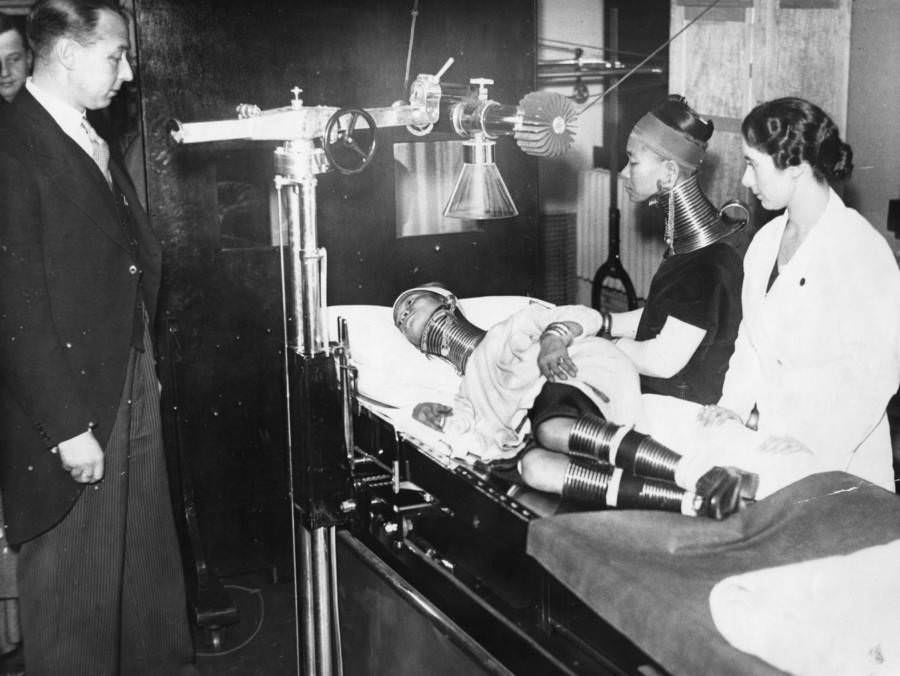
An unsettling hush seems to hang over the clinical room as doctors and attendants gather around a performer from Bertram Mills’ sideshow, presented in the title as the “Giraffe Necked Woman.” She lies on an examination table with metal neck rings stacked high, while another performer sits nearby wearing similar coils, their posture controlled and composed under scrutiny. A large, mechanical-looking apparatus looms above the bed, turning the scene into a stark meeting point between spectacle and medicine.
Taken in 1935, the photograph speaks to how “freak shows” were framed as both entertainment and supposed education, with medical authority used to legitimize public fascination. The performers’ bodies—modified, constrained, and displayed—become objects of measurement as well as curiosity, and the white coat at the bedside reinforces the era’s belief that classification could explain anything unusual. Yet the expressions and careful staging suggest agency, too: these were working professionals navigating a world that profited from difference.
For modern viewers searching for circus history, Bertram Mills’ show, or the long arc of medical examination in popular culture, this image offers a sharp, complicated document. It invites questions about consent, dignity, and the language once used to market human lives as attractions, even in spaces that claimed to be scientific. The result is a powerful historical photo that captures not just bodies on a table, but an entire social attitude frozen in time.