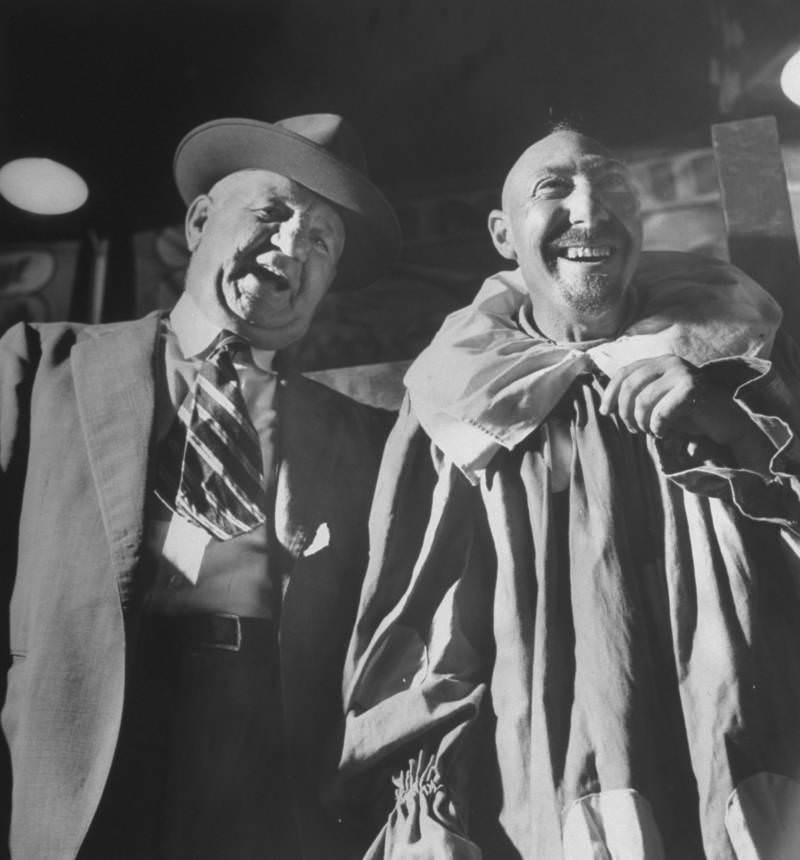
Laughing faces dominate this striking historical photo: two men lean toward the camera as if caught mid-joke, their expressions wide and unguarded. On the left, a heavier-set man in a suit, patterned tie, and brimmed hat stands in sharp light, while the man on the right—identified in the title as Julius Graubert—wears a draped garment that reads like a stage cloak or costumed wrap. The strong contrast and upward angle give the scene a lively, theatrical energy, suggesting a public setting rather than a private studio portrait.
The title’s period language, “the pinhead,” points to the world of sideshows and traveling entertainment where performers were routinely marketed with sensational labels. Seen today, that framing can feel jarring, yet the photograph itself complicates any simple reading: Graubert’s grin, the easy posture, and the companionable closeness between the two men hint at personality, camaraderie, and the everyday humanity behind the showman’s pitch. It’s a reminder that publicity terms often reduced people to a gimmick, even as they lived full lives beyond the banner.
For readers interested in circus history, carnival culture, and the visual record of old-time exhibitions, this image offers a candid look at how performers and their associates were presented—and how they chose to present themselves—in front of the lens. Details like clothing, lighting, and stance invite closer inspection, especially for anyone studying vintage entertainment photography and the social attitudes embedded in its captions. Whether encountered as curiosity or artifact, the photograph opens a conversation about spectacle, dignity, and the complicated afterlife of historic labels.