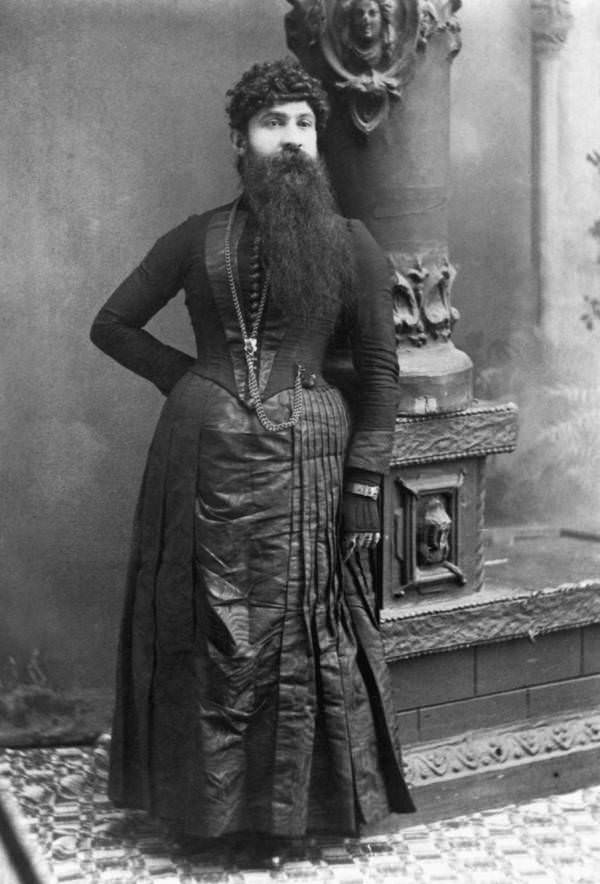
Madame Devere stands with practiced poise, her gaze turned slightly away as if accustomed to being watched, and the title’s claim of a 15-inch beard suddenly feels entirely plausible. The long, dark beard frames her face and reaches down toward the bodice of her dress, creating a striking contrast with her carefully arranged hair and the neat, high-collared silhouette typical of late-19th-century studio portraiture. Even without motion or sound, the photograph carries the quiet confidence of someone who understood exactly how attention worked.
Fashion details sharpen the sense of time and place: a fitted waist, a full skirt with sheen and structure, and jewelry that reads as deliberate rather than incidental. She poses beside ornate studio furniture and a decorative column, the kind of staged setting that signaled respectability while also turning the sitter into a spectacle for the camera. That blend of dignity and display fits the era’s fascination with “curiosities,” when bearded women were marketed to audiences even as they navigated public life on their own terms.
Set in Chicago, Illinois in 1890 and tied by the title to Brooksville, Kentucky, this portrait hints at the routes performers and exhibitors traveled through a rapidly modernizing America. It’s easy to file an image like this under “weird,” yet it rewards a slower look—at the craft of the photographer, at the sitter’s self-presentation, and at what Victorian viewers expected a woman’s body to be. For readers searching bearded woman history, sideshow culture, or uncommon Victorian portraits, Madame Devere’s image offers both an arresting face and a window into the social imagination of the Gilded Age.