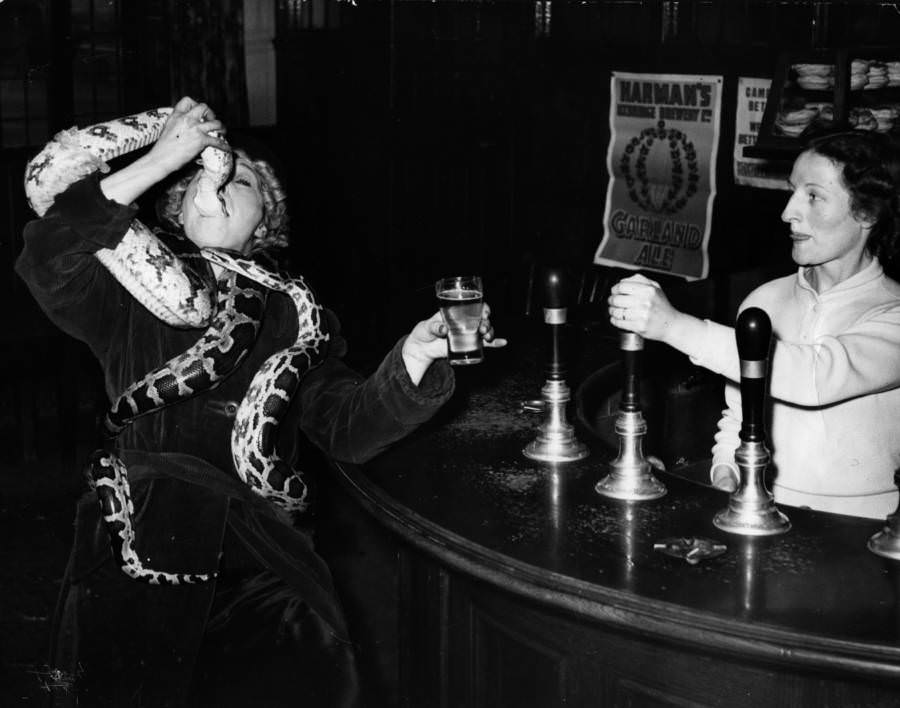
Millie Kayes leans back at the bar of the Peggy Bradford hotel and turns an ordinary drinking counter into a circus ring, the thick body of a python looped across her shoulders and lap. With one hand she tips the snake’s head toward her mouth, while the other keeps a glass raised as if the act were just another round ordered in good humor. The stark lighting and close framing make the moment feel both intimate and impossible, a 1952 snapshot of showmanship performed inches from the everyday.
Across the polished bar top, a woman watches with a calm, fixed attention that reads like the audience in miniature—half disbelief, half acceptance of the spectacle unfolding beside the beer taps. The scene is packed with period detail: the heavy wooden counter, the upright tap handles, and the advertising posters behind them anchoring this outrageous stunt in a recognizably mid-century setting. That contrast is the photo’s power, blending the familiar rituals of a hotel bar with the danger and theater of a sideshow performance.
Circus history often survives in grand posters and staged publicity shots, yet images like this preserve the gritty, improvised spaces where performers met the public on its own turf. The title’s claim of a 12-foot python adds to the legend of the act, but what endures is the tension between bravado and risk, and the way onlookers become part of the story simply by standing close enough to witness it. For readers searching vintage circus photos, oddball 1950s nightlife, or the stranger corners of hotel-bar entertainment, this photograph offers a vivid, unsettling window into popular culture at its most daring.