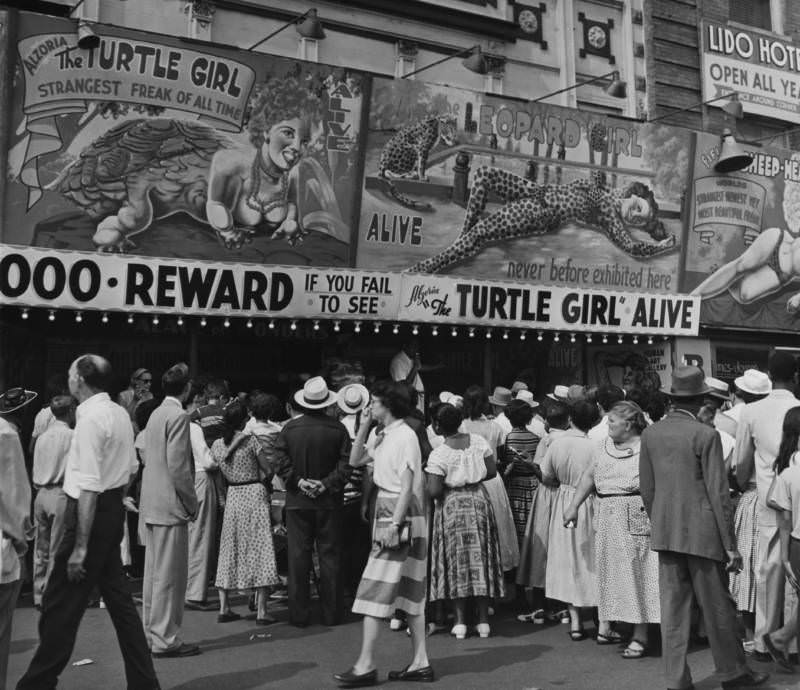
A crush of summer visitors gathers beneath towering, hand-painted banners promising “The Turtle Girl” and other sensational attractions on the Coney Island midway. The crowd’s hats, dresses, and rolled-up sleeves create a textured foreground of everyday life, while the bold lettering above—part carnival art, part hard sell—turns the façade into a billboard for curiosity. Even without hearing the barker, you can almost feel the pull of the queue as people edge forward toward the dark entrance.
Across the front, the wording is engineered to provoke: “strangest,” “alive,” and even a cash “reward” for those who don’t come in, all designed to make passersby stop and stare. The illustrated figures, posed like pinups with animal imagery, reveal how sideshows marketed bodies as spectacle, blending humor, shock, and titillation into a single visual pitch. It’s a snapshot of classic Coney Island entertainment culture—bright promises on the outside, a mystery behind the curtains.
Yet the line also hints at the uneasy legacy of the “freak show” era, when real people were often advertised as novelties for profit. Seen today, the scene invites a double reading: a lively record of American amusement history and a reminder of how popular culture once normalized exploitation in the name of fun. For anyone researching Coney Island sideshows, boardwalk crowds, or vintage carnival advertising, this photo offers a vivid, uncomfortable window into what audiences were encouraged to pay to see.