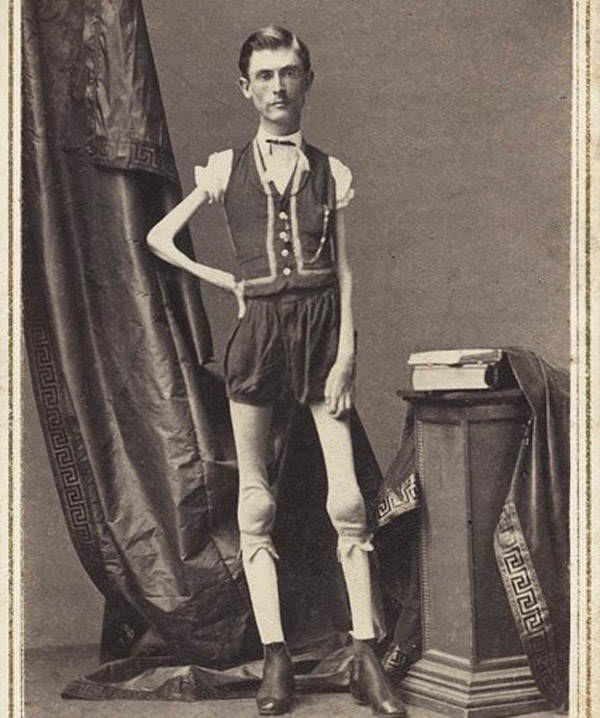
A slender young man stands posed in a studio setting, one hand set at his hip as if steadying himself for the long exposure. His tailored vest and short trousers draw the eye to an extraordinarily narrow frame, while the backdrop of heavy drapery and a small pedestal with stacked books signals the formal conventions of 19th-century portrait photography.
Billed in show advertisements as the “Living Human Skeleton,” Isaac Sprague became a public spectacle after an unexplained, irreversible loss of weight that began when he was about 12. The title attached to him is stark, but it also reveals the era’s appetite for medical mystery packaged as entertainment—where bodies that didn’t fit the norm were turned into attractions and photographed to be circulated, collected, and stared at.
Seen today, the 1866 portrait reads as both documentation and performance, balancing a composed gaze with the uncomfortable realities of exploitation and curiosity. For readers interested in Victorian sideshows, medical history, and the history of disability in popular culture, Sprague’s image offers a haunting entry point into how illness, identity, and commerce could intertwine in the age of cabinets, cartes-de-visite, and traveling exhibitions.