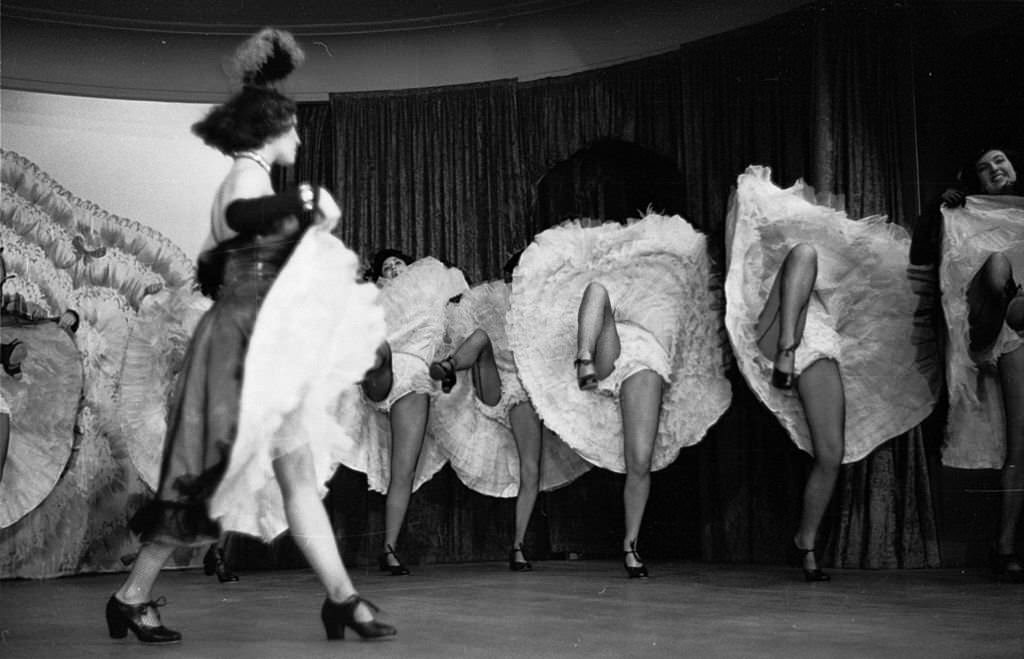
Feathered headpieces and a blur of lifted petticoats dominate the stage as a can-can line hits its mark in a performance billed as “The Blue Bird,” dated 1953. The dancers’ skirts, built from layers of ruffles, arc outward like bright fans, framing high kicks and pointed knees while the dark curtain behind them keeps the focus on motion. In the foreground, a lead performer strides across in heels, her costume’s darker fabric contrasting sharply with the pale, frothy underskirts that the routine is designed to reveal.
The can-can was always a choreography of spectacle and stamina—part precision drill, part dare—where timing mattered as much as bravado. Here, the troupe’s synchronized legwork and confident smiles underline why audiences in the mid-20th century still flocked to this enduring Parisian-style show dance, long after its 19th-century origins. The suggestion of “leaving little to the imagination” comes less from nudity than from the deliberate mechanics of exposure: the whip of the skirt, the flash of stockings, and the rhythmic repetition that turns flirtation into pattern.
Stage lighting, simple set dressing, and practical performance shoes hint at a working theater culture rather than a posed studio tableau, capturing entertainment as it was actually delivered night after night. The photograph also works as a small time capsule of 1950s fashion and performance aesthetics—structured costumes, theatrical feathers, and the continuing appetite for variety-style revue. As an artifact of dance history, it preserves the can-can’s signature combination of humor, athleticism, and showbiz audacity, all concentrated into one suspended moment of movement.