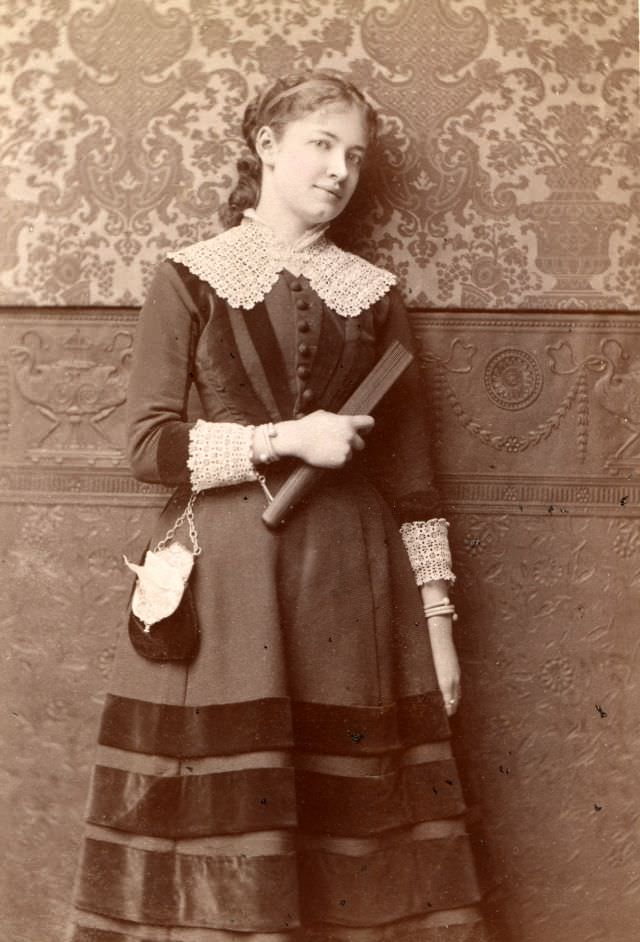
Leaning slightly against a richly patterned studio backdrop, a young Victorian-era woman poses with quiet confidence, her gaze turned off to the side as if caught between formality and daydream. The fitted bodice and smooth, structured skirt create the unmistakable late-19th-century silhouette, while crisp lace at the collar and cuffs adds a delicate, decorative contrast to the darker fabric. In her arms she holds a slim book or portfolio, and a small purse with a chain strap hangs at her side, details that hint at everyday respectability as much as portrait-pageantry.
Beneath such tailored outerwear sat the indispensable foundation of the period: the corset, engineered to shape the torso and support the drape of clothing above it. The narrow waistline and clean vertical lines visible here speak to that hidden architecture, where boning, lacing, and carefully cut seams disciplined the figure into the era’s fashionable proportions. Photographs like this are useful records of Victorian fashion and culture, showing how modesty, refinement, and physical constraint could be stitched together into a single, socially legible form.
What lingers is the tension between softness and structure—the lace and smooth hair set against the firmness of the dress’s fit, the relaxed hand balanced by the composed posture demanded by long exposures. Studio portraiture amplified these signals, surrounding sitters with ornate wallpaper and carved paneling to suggest stability and taste. As a glimpse into late 19th-century women’s clothing, the image evokes how a “tight corset” was not merely an undergarment, but a technology of style that shaped how women were seen, photographed, and remembered.