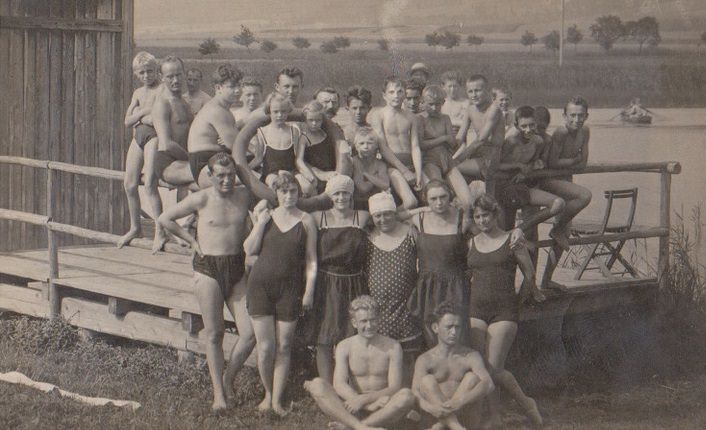
Crowded onto a simple wooden platform beside calm water, a mixed group of young athletes pose in swimwear with an easy confidence that feels both candid and carefully arranged. Bathing caps, practical one-piece suits, and sunlit skin point to a day devoted to training and shared recreation, while the lake and distant treeline suggest an organized outing rather than a private escape. The composition is dense with faces and bodies, the kind of group portrait meant to record belonging as much as physical form.
In the 1930s Soviet imagination, sport was more than leisure—it was a public statement about discipline, health, and the future, and the women at the center of scenes like this carried that message on their shoulders. Their sturdy silhouettes and straightforward attire match the era’s preference for function over ornament, reflecting how athletic culture promoted the “new” modern woman: capable, collective-minded, and unafraid of exertion. Even in a relaxed waterfront setting, the stance and proximity of the group speak to camaraderie and organized physical culture.
Strong Bodies, Strong Will invites a closer look at how vintage Soviet sports photos used everyday moments to reinforce ideals of resilience and unity. Details—the rough planks, the informal seating, the watchful expressions—anchor the image in lived experience, making it valuable to anyone searching for authentic 1930s Soviet sport girls, early swim training, or the history of women’s physical culture. Seen today, the photograph reads as both documentation and quiet propaganda, preserving a chapter where strength was styled as a social virtue.