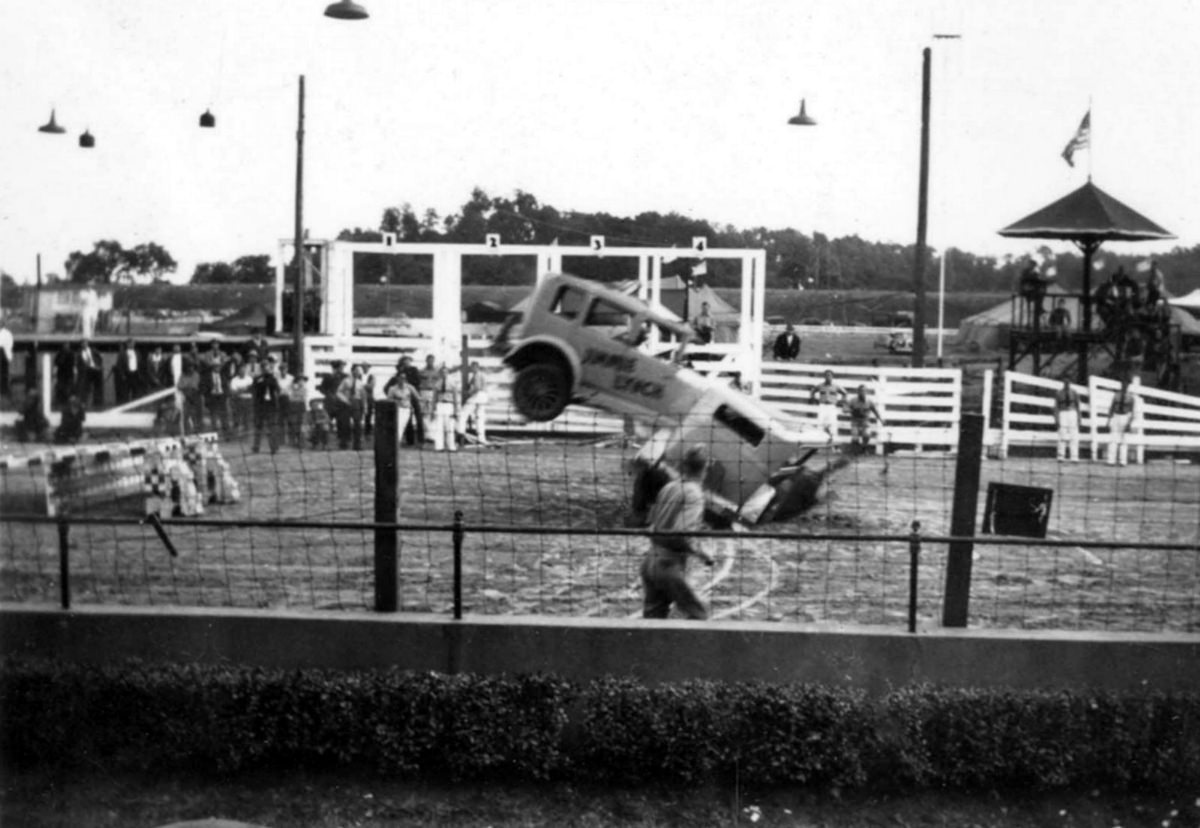
Mid-crash, a battered sedan rears up at a steep angle inside a fenced arena while spectators line the railings, watching the chaos with the kind of focus usually reserved for prizefights. The scene fits the legend of Jimmie Lynch and his “Death Dodgers,” a daredevil auto act that turned controlled wrecks into a crowd-pleasing sport during the 1940s. Even in a single frame, the blur of motion and the tilt of the car convey how close spectacle and catastrophe could feel in these performances.
Behind the airborne vehicle, numbered panels and sturdy white barriers hint at an organized program—less spontaneous demolition than choreographed mayhem designed for visibility and impact. A platformed stand with a roof and an American flag marks this as a public event, likely tied to fairs, speedways, or traveling shows where stunt driving drew families and thrill-seekers alike. The ring-like layout also emphasizes the era’s approach to safety: separation by fence and distance, with the performers taking the real risks inside the enclosure.
As a piece of 1940s sports and entertainment history, the photograph captures a moment when automobile culture fed directly into popular spectacle—part motorsport, part stunt theater, part endurance test. Lynch’s team built their reputation on precision timing, tough cars, and nerves that held when metal buckled and tires lifted off the ground. For readers interested in vintage stunt shows, daredevil driving, and the public’s fascination with danger, this image offers a vivid doorway into the world of crash-to-thrill performance.