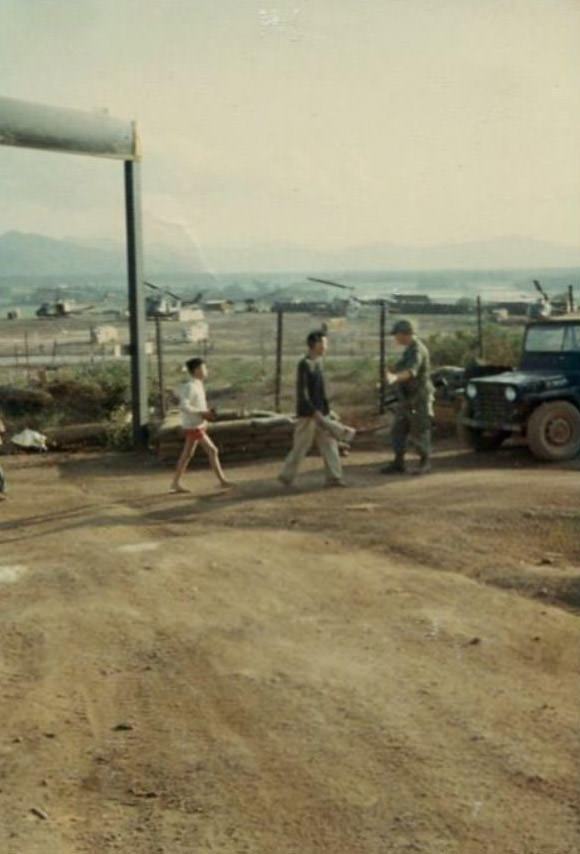
Under a pale sky and a haze of distant hills, a Vietnamese man and a boy move along a dusty road while an Army soldier steps in to halt them. The soldier’s posture and the pair’s close, cautious spacing convey the power imbalance of a wartime checkpoint, where a walk down the road could suddenly become an interrogation. A military vehicle waits nearby, grounding the moment in the everyday machinery of control that shaped so many encounters during the Vietnam War.
Behind them, a fenced perimeter and scattered equipment stretch across the landscape, hinting at a base area on the edge of cultivated land. The open terrain and utilitarian structures make the scene feel temporary—built for the needs of the moment, then destined to vanish—yet the human tension remains immediate. Nothing in the frame suggests spectacle; instead, it’s the ordinary process of being stopped, examined, and directed that tells the story.
Images like this complicate easy narratives of combat by focusing on civilians and detainees caught in the routines of military operations. The title’s reference to the 2nd Battalion situates the photograph within unit-level activity, where patrols and checkpoints blurred the line between security and fear. For readers searching Vietnam War history photos, prisoner treatment, or Army checkpoint scenes, this post offers a sober reminder that war was often experienced in these quiet, consequential pauses.