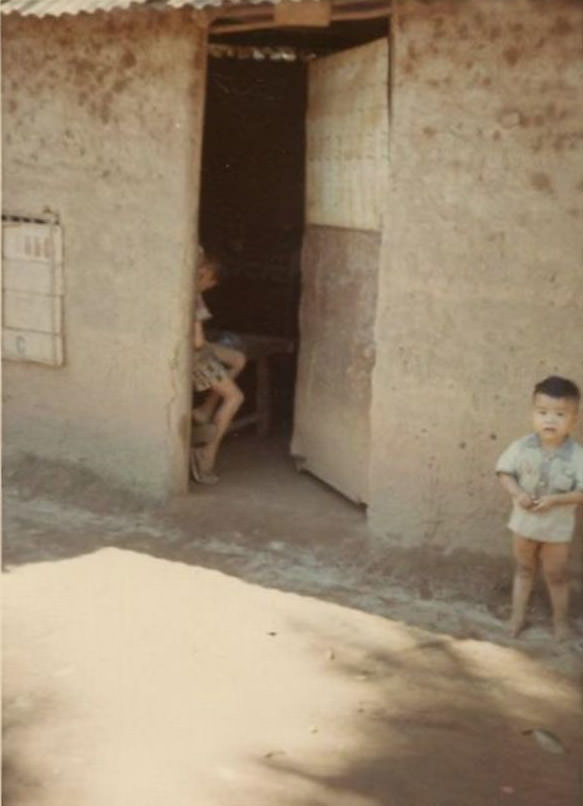
Sunlight spills across a dusty yard and stops at the threshold of a modest Vietnamese home, where a toddler boy stands barefoot near the wall, looking outward with a quiet, watchful stillness. The doorway is left open, its door angled wide, turning the entrance into a stark frame between the bright exterior and a deep, shadowed interior. In the background, another small figure lingers just inside, half-hidden by darkness, hinting at the everyday life unfolding beyond what the camera can easily see.
Mud-plastered walls and a corrugated roofline suggest practical construction meant to withstand heat and heavy rains, while the rough ground speaks to a rural or village setting in South Vietnam. The simplicity of the scene is part of its power: no uniforms, no weapons, only the domestic architecture and children’s presence—ordinary details that often vanish from grand narratives of the Vietnam War. Even so, the tension of the era seems to hover at the edges, as if the open door doubles as an invitation and a warning.
Moments like this help anchor Vietnam War history in the textures of civilian life, reminding viewers that conflict was lived in homes and courtyards as much as in jungles and headlines. The unidentified house and unnamed children keep the photograph universal, inviting careful attention rather than easy conclusions. For readers searching for Vietnam War era photos, South Vietnam village life, or historical images of Vietnamese homes, this entrance scene offers an intimate glimpse into resilience, routine, and childhood under uncertainty.