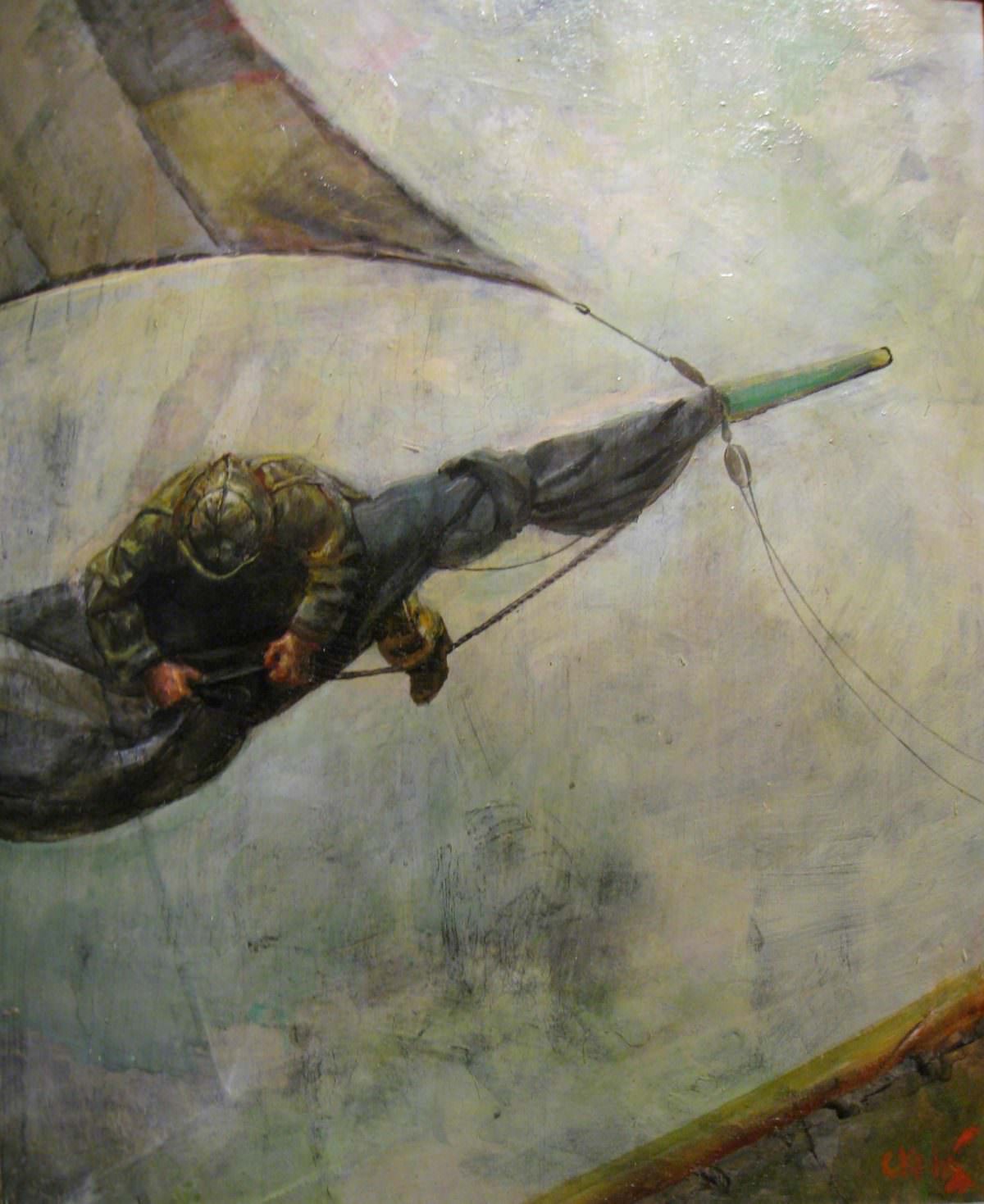
Wind and canvas dominate the scene in “Furling Sail, 1900,” where a lone sailor clings to the rigging and leans into the task of taming a heavy, dark sail. The perspective pulls the viewer upward, close to the boom and lines, turning a routine maneuver into a moment of suspense. Muted grays and sea-worn greens suggest spray, weather, and the constant motion that defined work aloft.
At the heart of the composition is labor, not spectacle: gloved hands, bent posture, and taut ropes convey the practiced choreography of seamanship. The sail, gathered and tightened, reads like a storm cloud being bound in place, while the surrounding haze leaves little to anchor the eye except the man, the gear, and the wind’s invisible force. It’s an intimate reminder that maritime history is built from countless such actions, repeated under shifting skies.
For collectors and readers searching for nautical art, maritime photography, or turn-of-the-century seafaring imagery, this piece offers a striking study of technique and endurance. The title “Furling Sail, 1900” places it at the threshold of a new century, when sail and modernity often shared the same horizon. Whether viewed as artwork or historical document, it lingers as a portrait of skill—one figure suspended between canvas and air, shaping the ship’s next move.