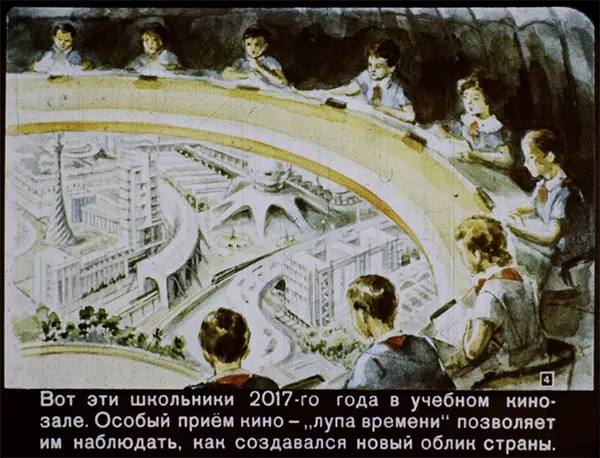
Across the curved rows of a school cinema hall, a circle of students leans forward as if the screen itself were a window cut into the future. The artwork frames them in soft, painterly tones while the center opens onto an intricate panorama of highways, bridges, and dense city blocks—an imagined landscape of modern infrastructure. Faces and uniforms are sketched with economy, yet the mood is unmistakable: focused curiosity, the hush of a classroom turned theater.
Set up as a “time loop” viewing device, the scene suggests an educational spectacle where progress is not merely taught but projected. The screen’s sweeping arc functions like a lens, pulling the viewer’s eye into the engineered geometry of overpasses and civic buildings, where the “new face” of a country is rendered in concrete lines and ambitious scale. With Russian text anchoring the message, the image reads like a piece of visual propaganda and pedagogy at once—part lesson, part promise.
For a WordPress post on historical illustration and visual culture, this piece offers rich ground for exploring how schools, cinema, and state narratives intersect. It invites readers to think about the era’s fascination with technology and planning, and how children were positioned as witnesses to transformation—literally seated around a screen that makes modernization feel inevitable. As an SEO-friendly snapshot of educational cinema, futurist city imagery, and Cold War–era hopes (and tensions), it turns “Artworks” into a story about how nations tried to teach the future.