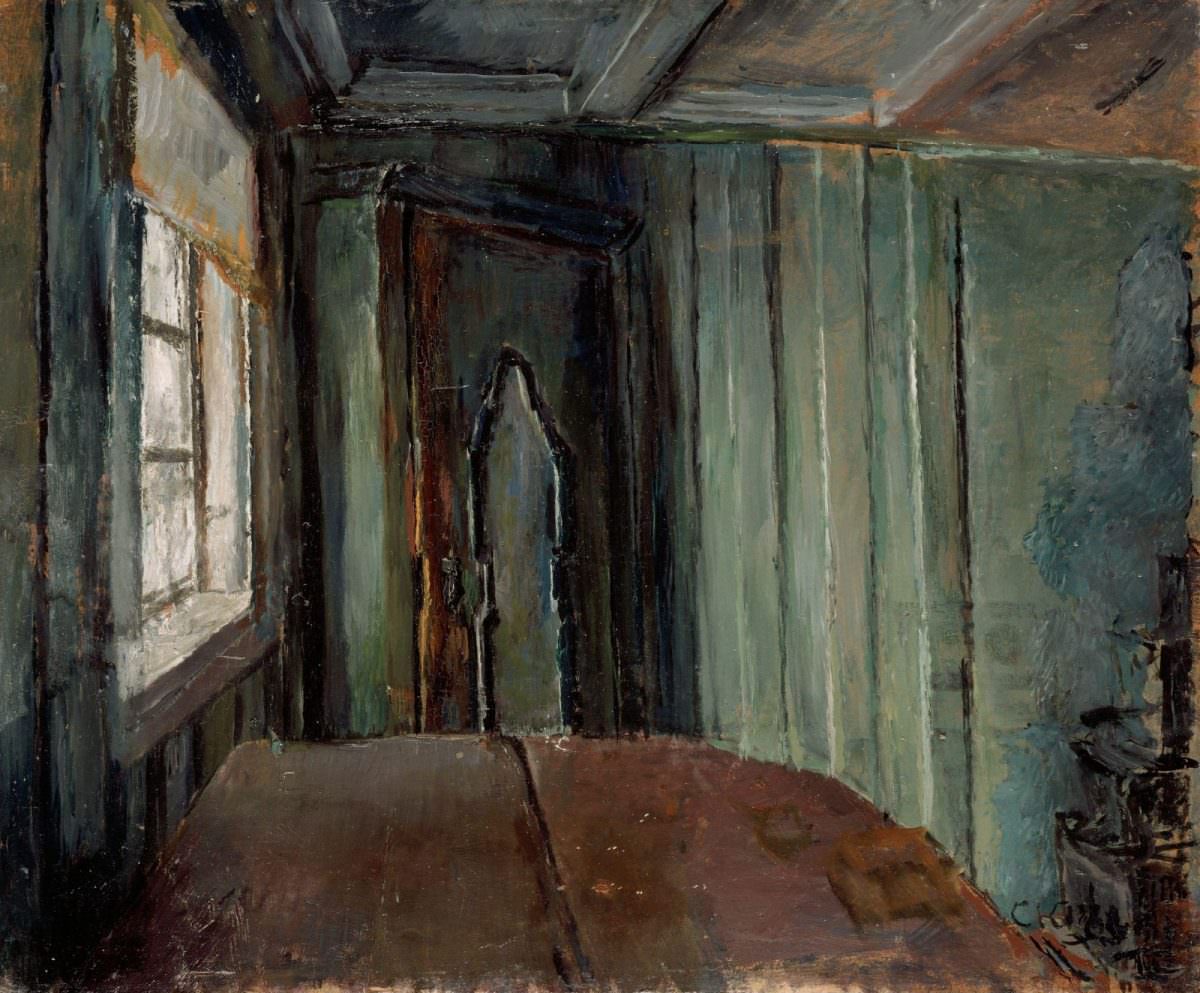
Muted greens dominate the room, layered in quick, expressive brushstrokes that make the walls feel both solid and unsettled. A pale window on the left admits a cool wash of light, sharpening the edges of the frame while leaving corners to dissolve into shadow. The title, “The Green Room, 1920,” hints at a space meant for waiting—quiet, private, and slightly theatrical in its restrained drama.
At the center, a tall mirror (or a mirror-like form) rises against the far wall, a narrow vertical that pulls the eye inward and deepens the sense of distance. The floorboards angle toward that focal point, creating a corridor effect that turns an ordinary interior into a small stage. Even without figures, the empty space suggests presence: footsteps just gone, a door just closed, a moment held between scenes.
As an artwork rooted in early 20th-century sensibilities, this interior study leans on color and geometry rather than ornament, inviting close looking and personal interpretation. Readers searching for “The Green Room 1920” will find an evocative historical image of domestic or backstage atmosphere, where light, paint, and perspective do most of the storytelling. It’s a compelling example of how a simple room can become a portrait of mood—quiet, spare, and unforgettable.