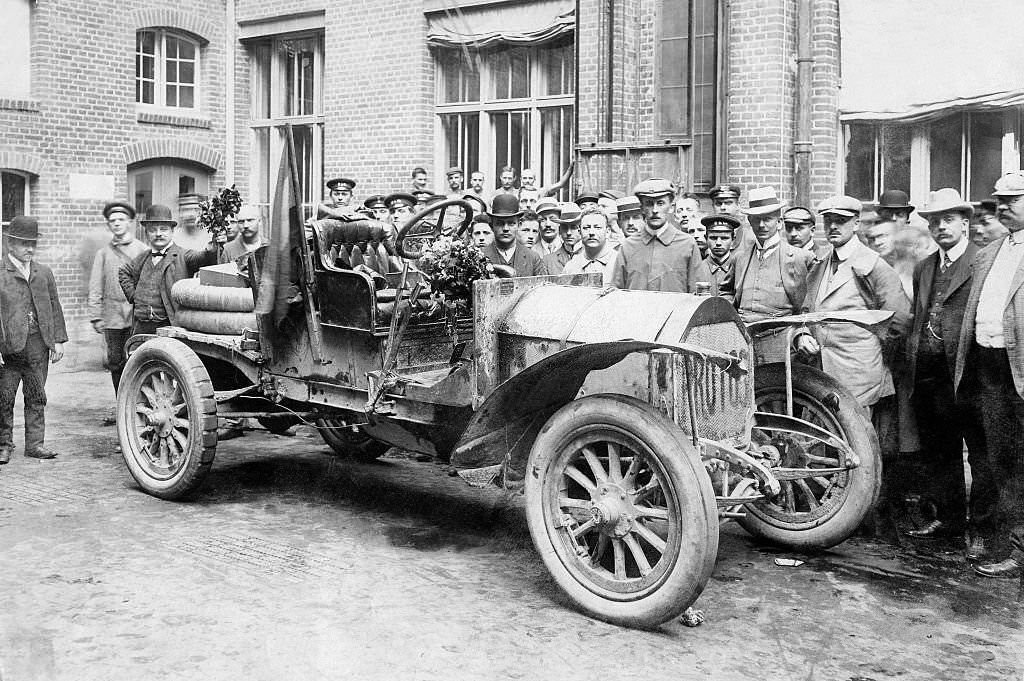
In a Berlin courtyard at the Ullstein house, a Protos car sits like a returning prizefighter—mud-splashed, rugged, and unmistakably modern for its era—while a tight ring of onlookers presses in to study every detail. Faces tilt toward the exposed bodywork and towering wheels, and the crowd’s mix of hats and uniforms hints at how quickly motor racing had become a public spectacle. The setting feels half newsroom, half workshop, where a machine’s story could be inspected up close before being turned into tomorrow’s headline.
The car itself tells a tale of endurance: oversized tires, a high stance, and a utilitarian chassis built for punishing roads rather than polished boulevards. Bundles and supplies are strapped aboard, and the open seating emphasizes how raw early automotive engineering could be, with little separating driver from weather, grit, or danger. Even without reading a caption, the scene suggests a long-distance challenge where reliability mattered as much as speed.
Connected to the wider lore of the Great New York to Paris Auto Race, this moment in Berlin underscores how international and news-driven early motorsport had already become. The Ullstein courtyard becomes a stage where technology, ambition, and public curiosity collide—part celebration, part scrutiny, and part proof that the automobile was reshaping everyday imagination. For anyone exploring vintage racing photos, Protos, or Berlin’s early 20th-century street life, the image offers a textured snapshot of a world learning to trust machines over miles.