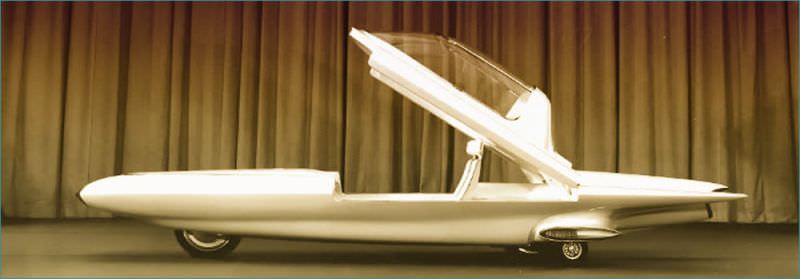
Gleaming like a prop from a mid-century science-fiction set, the 1961 Ford Gyron sits low and slender on just two wheels, its long, torpedo-shaped body emphasizing speed even at rest. A dramatic canopy-style door is raised upward, hinting at an aircraft influence and inviting the viewer to imagine climbing into a cockpit rather than a conventional cabin. Photographed against stage curtains, the gyrocar reads as a deliberate showpiece—part engineering experiment, part rolling sculpture meant to stop crowds in their tracks.
What makes the Gyron so fascinating in automotive history is the promise behind its “two-wheeled car” concept: stability through gyroscopic technology rather than the usual four-corner stance. The streamlined nose, smooth flanks, and minimal ground contact point to a period when designers chased futuristic aerodynamics and manufacturers tested bold ideas for research and marketing. Even without technical schematics in view, the proportions and presentation communicate a prototype mindset—an invention built to prove a point and spark conversation about what personal transportation could become.
For collectors, enthusiasts, and anyone exploring concept cars of the 1960s, this image offers a striking snapshot of Ford’s experimental imagination at full stretch. The Gyron remains an enduring symbol of the era’s optimism, when auto shows and promotional photography were stages for radical prototypes that might never reach the road. As you study the lifted canopy, the knife-clean silhouette, and the theatrical display setting, it’s easy to see why the 1961 Ford Gyron still draws attention in searches for gyrocar design, two-wheeled vehicles, and vintage automotive inventions.