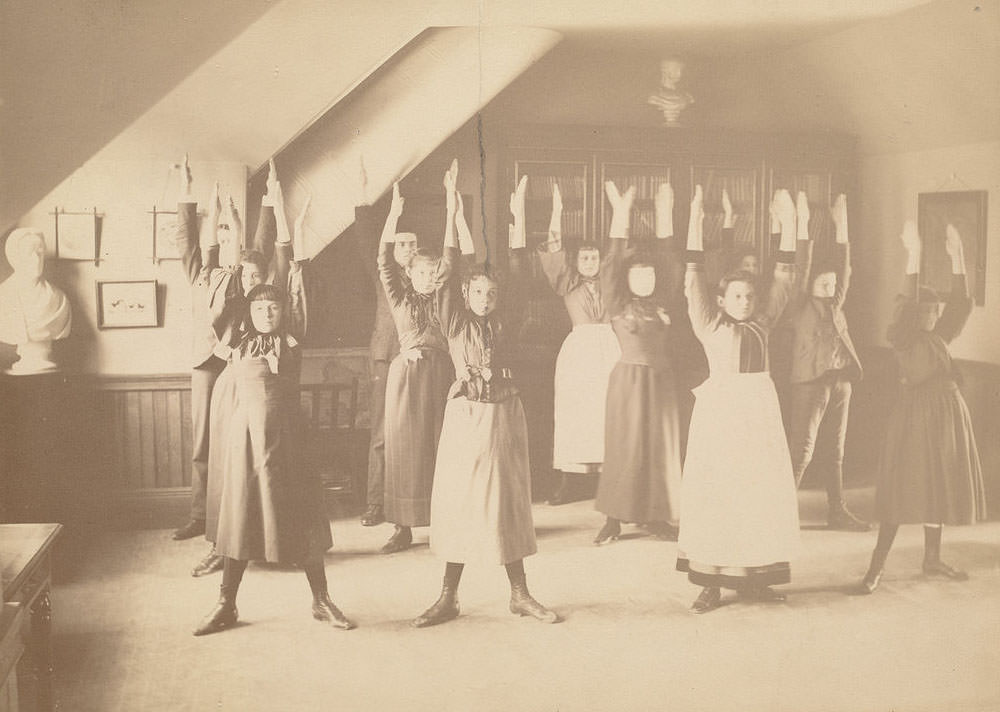
Arms lifted in unison, a line of Boston school students turns a simple classroom into a makeshift gymnasium, their posture crisp and their expressions focused. Long skirts and aprons—everyday schoolwear rather than athletic uniforms—move with the routine, revealing how late-19th-century “physical culture” was fitted into ordinary school life. The room’s details, from wall-mounted apparatus to framed diagrams and a classical bust, hint at an era that linked education with discipline, health, and moral improvement.
What stands out is the choreography of order: each child occupies a precise place, each gesture echoed across the group, suggesting a teacher’s counted cadence just beyond the frame. These rare historical photos of students exercising in the 1890s capture the early roots of physical education in Boston’s schools, when calisthenics and drills were promoted as modern, scientific training for young bodies. Even the soft, aged tones of the print add to the sense of a structured moment preserved from a rapidly changing city.
For readers drawn to Boston history, vintage school life, and the origins of organized youth sports, this scene offers more than nostalgia—it shows how “sports” could begin as synchronized movement indoors, long before today’s gym classes and team programs. The photograph invites close looking at clothing, classroom furnishings, and the social expectations written into a collective routine. Taken together, these images help explain how the 1890s shaped ideas of fitness, discipline, and schooling that still echo in education today.