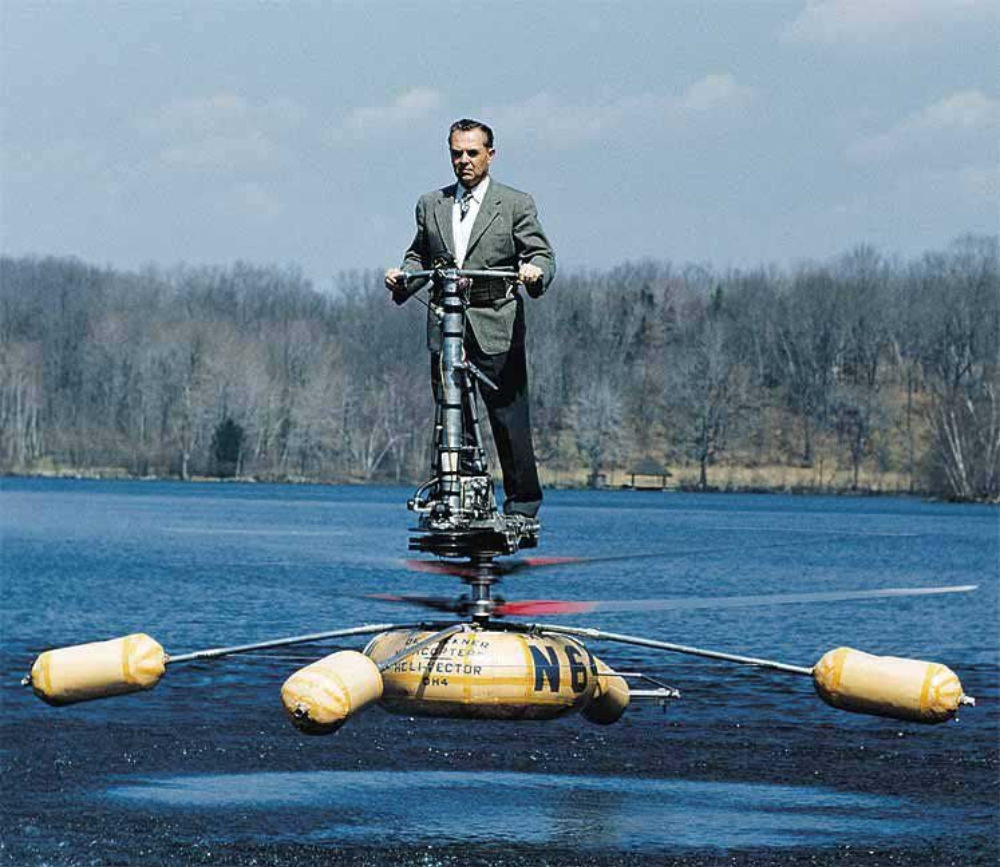
Balanced above a spinning rotor on a tiny platform, a test pilot stands upright as if riding a mechanical broomstick, gripping handlebars while the de Lackner HZ-1 Aerocycle hovers just above the water. The craft’s minimal frame, exposed machinery, and float-like outriggers make it look more like an experiment than a conventional helicopter, a stripped-down attempt to shrink vertical flight to a one-man personal vehicle. In the background, a calm shoreline and bare trees underscore how surreal the scene is: a lone figure poised over a whirring disc of blades with almost nothing around him for protection.
Born from 1950s optimism about individual mobility and battlefield innovation, the Aerocycle promised quick lift and simple operation—an airborne equivalent of a scooter. Yet the very simplicity that made it alluring also exposed its weaknesses, especially the unforgiving dynamics of a small rotorcraft with the rider standing high above the spinning hub. Even without close-up detail, the photograph telegraphs risk: no cockpit, no fuselage, and a stance that leaves balance and stability to engineering that was still being proven in real time.
Failure during flight testing is part of what makes the HZ-1 Aerocycle historically compelling, a reminder that many “future” machines reached the public imagination long before they achieved practical safety. For readers interested in experimental aviation, Cold War-era inventions, and the history of personal helicopters, this image is a vivid snapshot of ambition meeting hard aerodynamic reality. The Aerocycle’s story fits neatly into the broader lineage of prototypes that influenced later designs—not by succeeding as products, but by revealing what one-man vertical flight truly demanded.