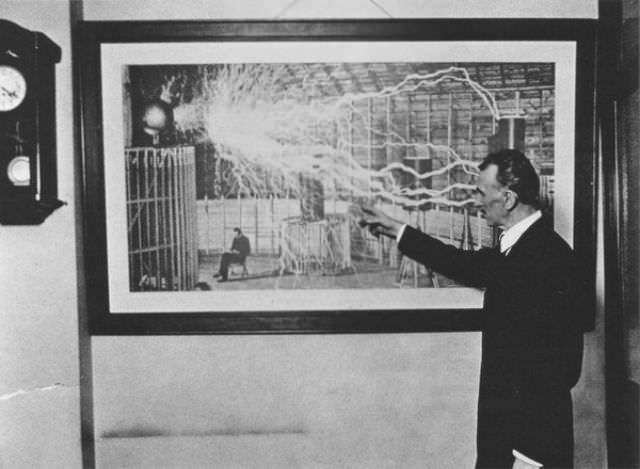
Nikola Tesla stands in profile beside a framed enlargement, arm extended as if guiding the viewer’s eye along a jagged ribbon of electricity. The scene is part lecture, part theatre: a suited inventor pointing into a storm of light trapped on photographic paper, inviting onlookers to imagine the crackle and sharp scent of ozone beyond the frame. Even without sound, the gesture suggests confidence—an engineer translating a violent natural effect into something that can be demonstrated, discussed, and remembered.
The title ties two moments together, and that contrast is the story: Tesla in 1916 presenting an earlier Colorado Springs photograph from 1899. In the enlarged image, a powerful discharge blooms near a large apparatus, with branching arcs reaching outward like lightning in miniature; it’s a visual shorthand for the high-voltage experiments that helped define Tesla’s reputation in the history of electricity. The composition also hints at the era’s fascination with new technologies—how photography, exhibitions, and public demonstrations turned laboratory work into compelling proof for curious audiences.
For readers browsing inventions, early electrical engineering, or Tesla’s Colorado Springs experiments, this post offers a striking doorway into turn-of-the-century science culture. It reflects how Tesla curated his own legacy, using a dramatic photograph to communicate scale, ambition, and the promise of wireless power and high-frequency currents. As a historical artifact, it’s not only about the discharge itself, but about the moment an inventor points to an image and turns experimentation into enduring myth.