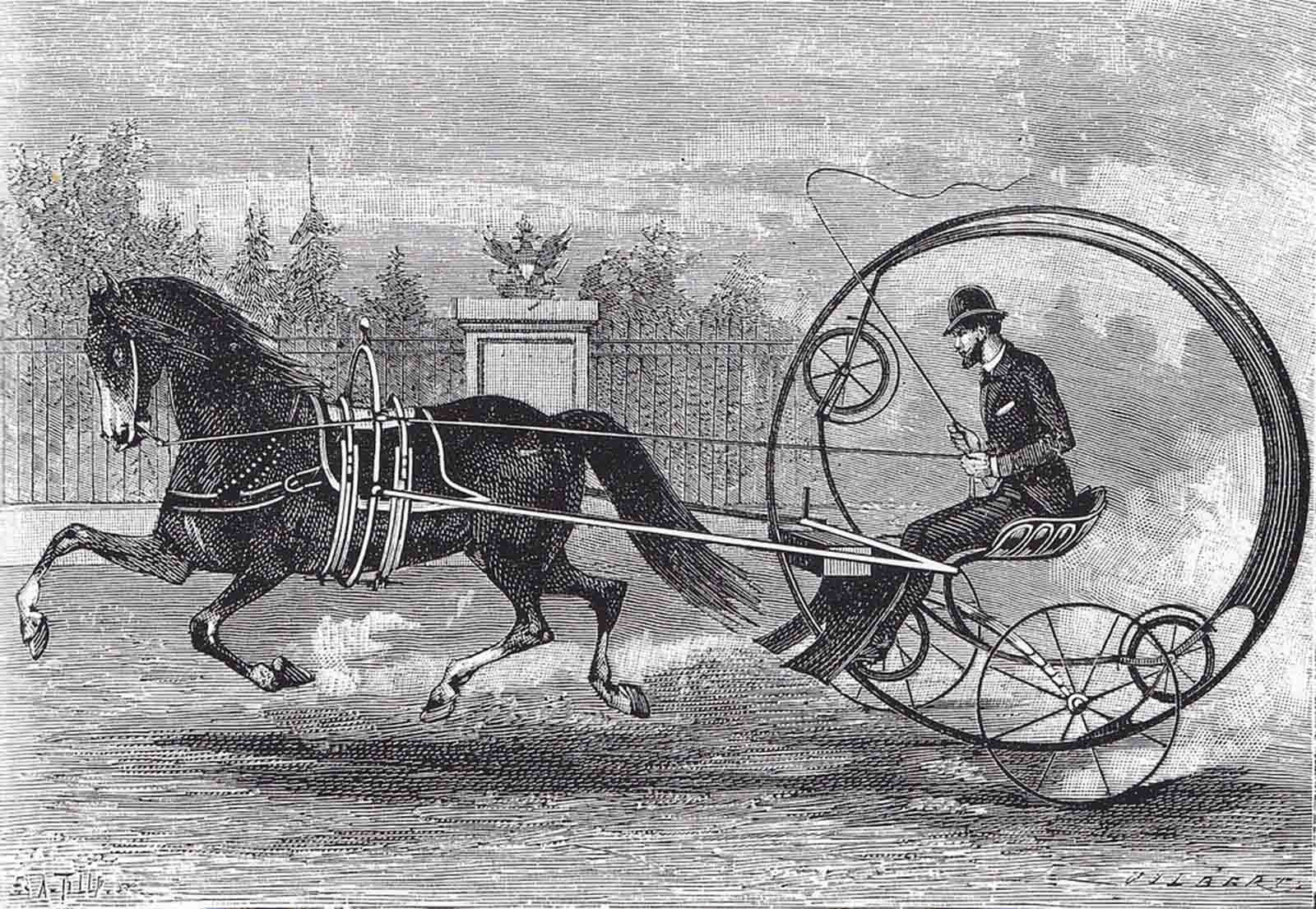
A horse surges forward at a full stretch while, behind it, an astonishing single-wheel carriage rolls along like a mechanical hoop. The driver sits inside the great ring, reins in hand, framed by curved metalwork and a spidery set of braces that connect the animal to the monowheel. Fine engraving lines emphasize speed and vibration, hinting at the rattle such an invention must have produced on real roads.
In the late 19th century—roughly the 1870–1890 window suggested by the title—designers were hungry to rethink transport, experimenting with bicycles, tricycles, and ever more daring carriage engineering. This one-horse monowheel design reads like an attempt to reduce rolling resistance and streamline motion by putting most of the vehicle’s mass into a single, oversized wheel. The small auxiliary wheels and exposed linkage suggest a compromise between bold theory and practical stability, as inventors tried to keep a passenger upright while a horse did the pulling.
Even without a confirmed date or place, the scene speaks to an era when innovation often arrived first as an illustration, inviting readers to imagine the future before it could be built reliably. Details like the fence line, distant trees, and the rider’s formal attire ground the contraption in everyday life, making the engineering feel both audacious and oddly plausible. For anyone exploring Victorian inventions, early transportation history, or unusual carriage concepts, this monowheel horse vehicle offers a vivid glimpse of creativity on the cusp of the modern age.