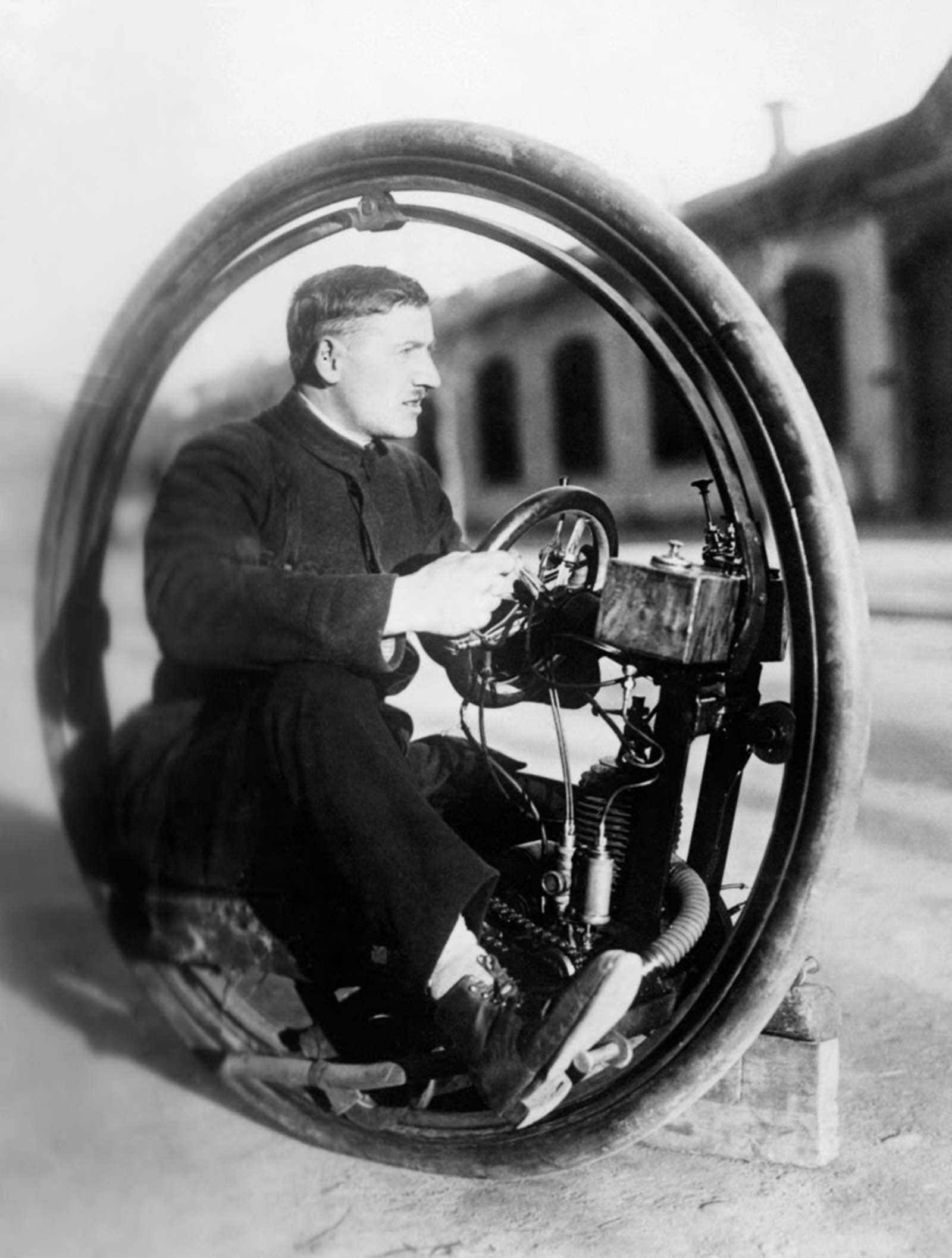
Signor Davide Cislaghi sits low inside a towering circular wheel, hands on a compact steering wheel as if he’s piloting a machine from the future rather than the early 1920s. The “Monowheel” surrounds him like a steel halo, its thick tire forming both the vehicle’s body and its only point of contact with the road. In the foreground, the curved frame and exposed mechanical parts make the contraption feel half motorcycle, half rolling experiment.
Look closely and the engineering philosophy becomes clear: strip transportation down to a single wheel, then build the rider’s seat, controls, and motor directly within it. Pipes, wiring, and a boxy housing crowd the small cockpit, while pedals and footrests hint at the careful coordination needed to stay stable. The photo’s blurred background architecture keeps attention on the monowheel’s unusual geometry, emphasizing how radically it broke with the familiar two-wheeled silhouette.
In 1923, claims that this one-wheel motorcycle could reach speeds up to 40 mph would have sounded thrilling—and a little alarming—to anyone accustomed to standard bikes and early cars. Images like this capture the inventive spirit of the interwar years, when personal transport inspired bold prototypes and mechanical showmanship. For readers drawn to vintage inventions, early motorcycle history, and experimental vehicles, Cislaghi’s monowheel remains a striking reminder that progress often rolls forward on odd ideas.