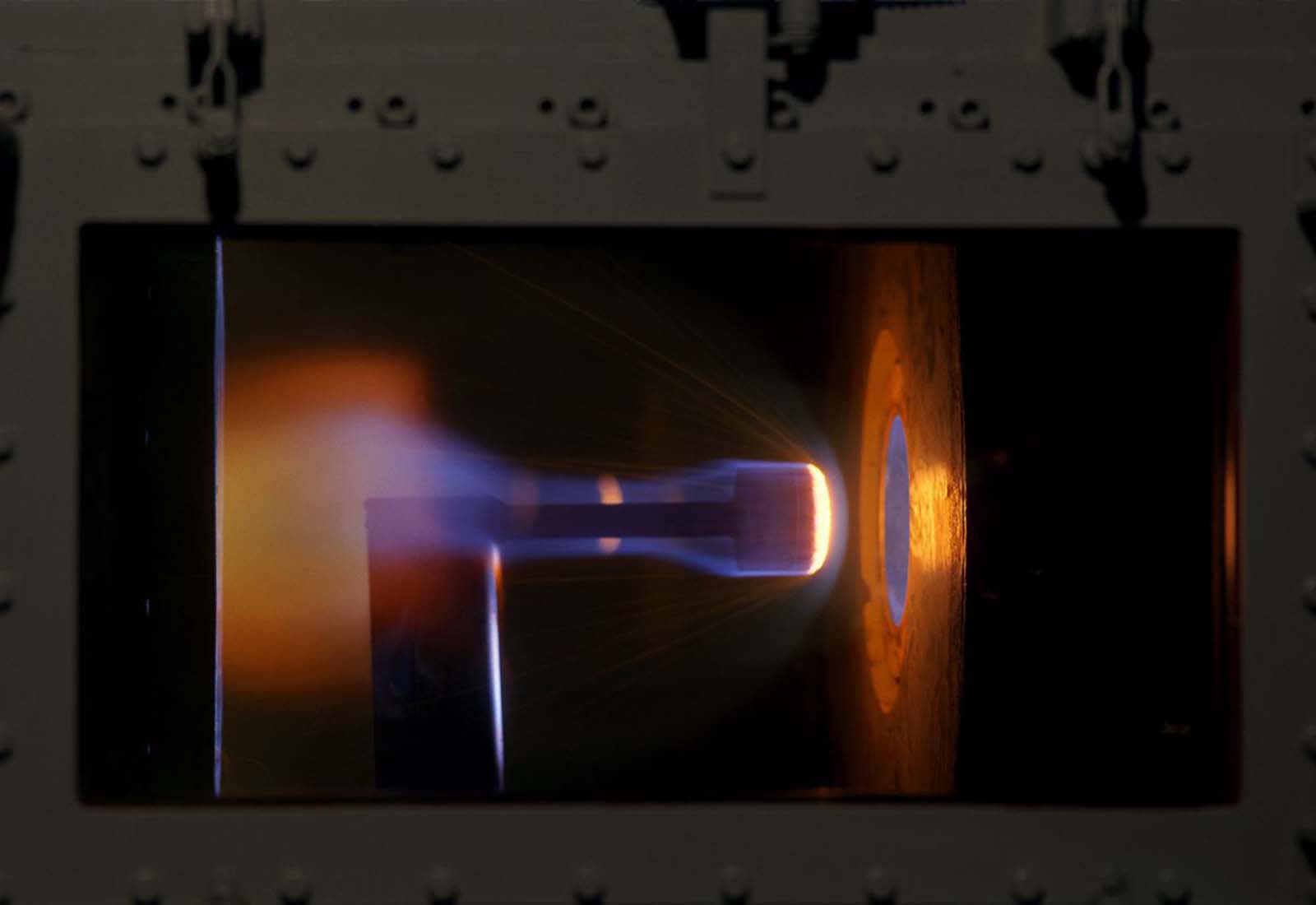
Inside a test chamber, a narrow jet of heat blooms into blue and orange as it strikes a small sample, turning the scene into a controlled imitation of atmospheric reentry. The photo’s framing—viewed through a thick, bolted window—reminds you that the real subject isn’t the flame itself, but the barrier between extreme temperature and the hardware meant to endure it. In 1975, as the Space Shuttle program moved from concept to practical engineering, such laboratory trials were where “thermal protection” became something measurable, repeatable, and trustworthy.
What looks almost delicate at the center is likely a piece of candidate thermal insulation material being pushed to failure points and safety margins, watched for cracking, charring, erosion, or heat soak-through. High-temperature testing like this helped engineers compare formulations, bonding methods, and surface behaviors under intense thermal loads, simulating the harsh conditions a spacecraft would face. The glow on the target surface and the concentrated flame suggest a focused heating method designed to deliver consistent, instrument-friendly data rather than spectacle.
For readers interested in inventions and aerospace history, this image captures the often-invisible side of spaceflight: materials science, test rigs, and incremental improvements that made reusable spacecraft plausible. Long before launches and landings became televised milestones, the Space Shuttle’s heat-resistant insulation had to prove itself in rooms like this, one sample at a time. It’s a powerful reminder that space exploration is built as much in furnaces and labs as it is on launch pads.