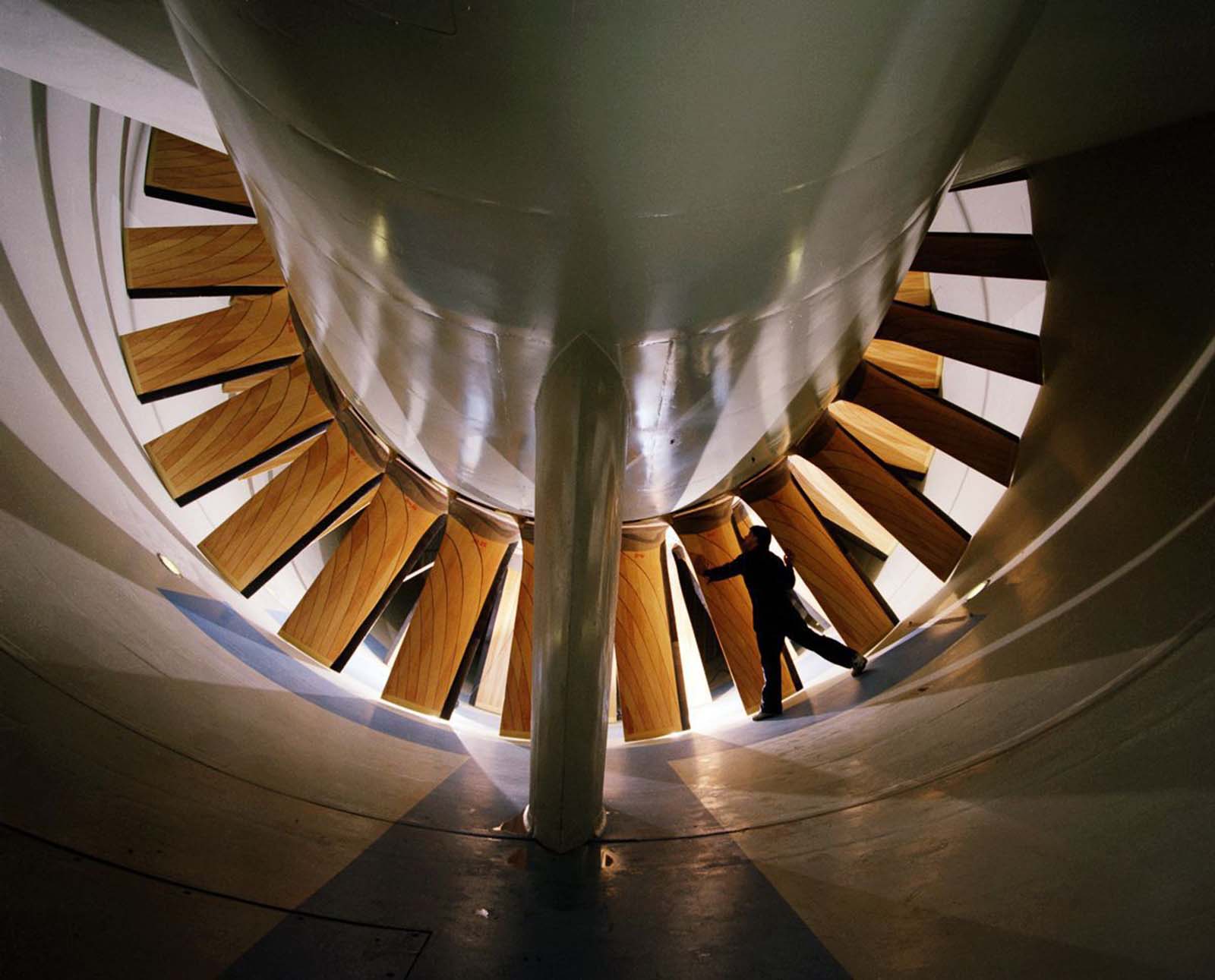
Beneath the smooth, metallic hub of an enormous tunnel fan, the curved ducting becomes a kind of industrial cathedral, lit by bright panels that rim the circumference. The wooden-toned blades radiate outward in a precise pattern, their scale emphasized by the lone worker standing on the inner surface, dwarfed by the machinery. Even at rest, the scene suggests motion—an engineered promise of controlled wind, pressure, and speed.
Taken at Langley Research Center in 1990, the photo highlights one of the two 34-foot-diameter fans that drive the 16-Foot Transonic Tunnel, a facility designed to replicate the demanding airflow conditions aircraft encounter near the speed of sound. Transonic testing occupies that tricky regime where shock waves and rapid changes in drag can appear, and massive equipment like this was built to make those invisible forces measurable. The image fits squarely within the story of inventions: not a single gadget, but a system—power, structure, and precision working together to turn air into data.
The human figure at the edge provides more than scale; it hints at the hands-on maintenance and careful inspection required to keep a research wind tunnel reliable. From the warm grain of the blades to the cool sheen of the housing, the contrasts underline how many materials and disciplines converge in aerospace engineering. For readers interested in NASA history, wind tunnel technology, and the mechanics behind flight research, this photograph offers a memorable look inside the infrastructure that helped shape modern aeronautics.