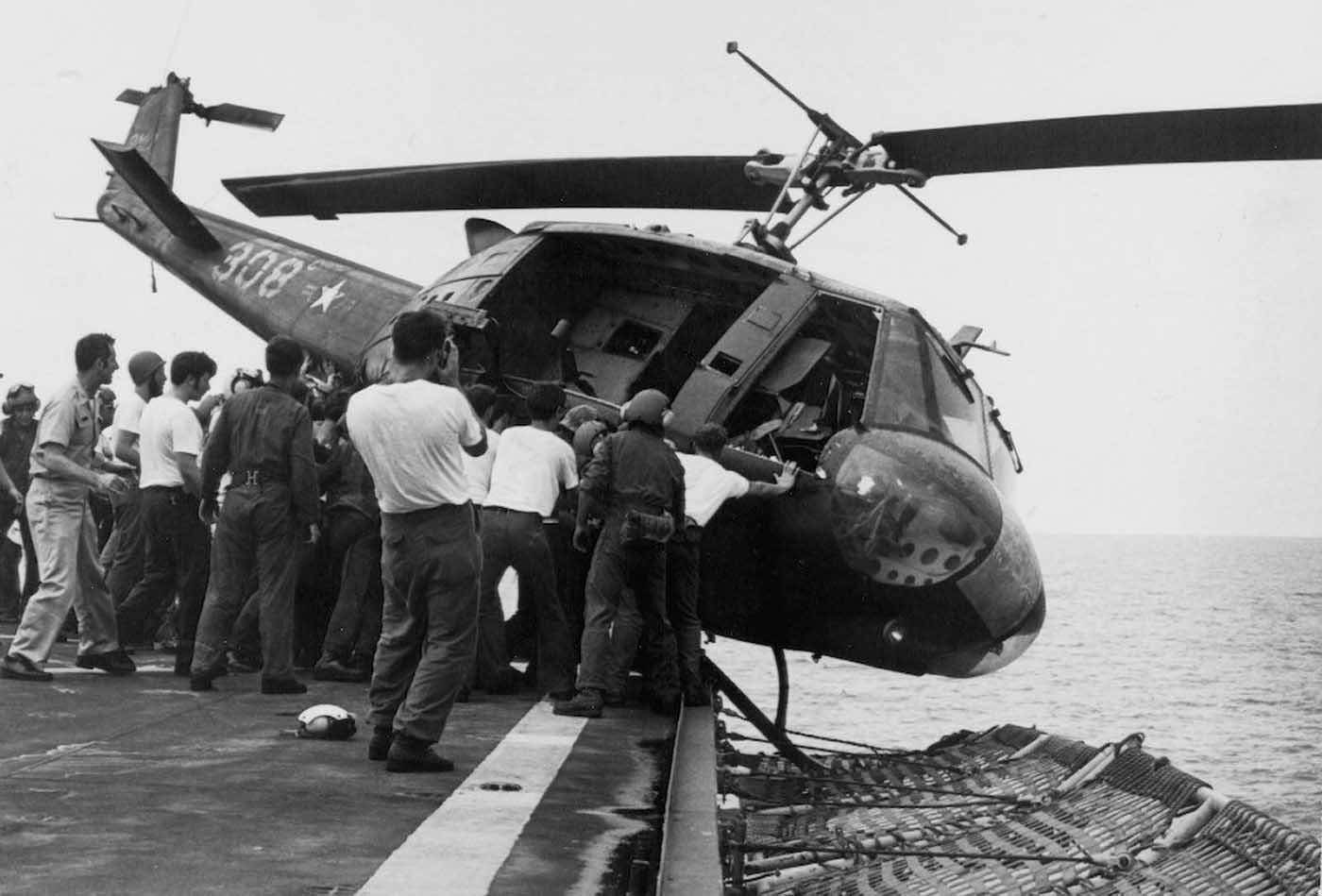
Men crowd the flight deck with their hands braced against a helicopter’s fuselage, shoving its nose toward the ship’s edge while the sea waits below. The rotor blades sit still, the cabin yawns open, and the aircraft’s weight seems to fight every inch of movement. In that strained moment, the viewer can almost hear shouted instructions and feel the urgency that turns a machine into an obstacle.
The title points to one of the Vietnam War’s most starkly practical choices: clearing precious deck space so more evacuees could be brought aboard. Pushing helicopters overboard looks shocking out of context, yet in the chaos of late-war evacuations it became a grim form of triage—sacrificing equipment to save time, space, and lives. The photograph distills that dilemma into a single frame where duty, logistics, and human desperation collide.
As a piece of Vietnam War history, this image captures the frantic tempo of helicopter evacuations at sea and the hard decisions made by U.S. forces during the conflict’s final days. It’s also a reminder that “evacuation” is not a clean narrative but a chain of hurried compromises, carried out by ordinary hands on an unforgiving deck. For readers searching for 1975 Vietnam evacuation photos or accounts of helicopters pushed overboard, this scene offers an unforgettable glimpse of what emergency rescue looked like when every landing spot mattered.