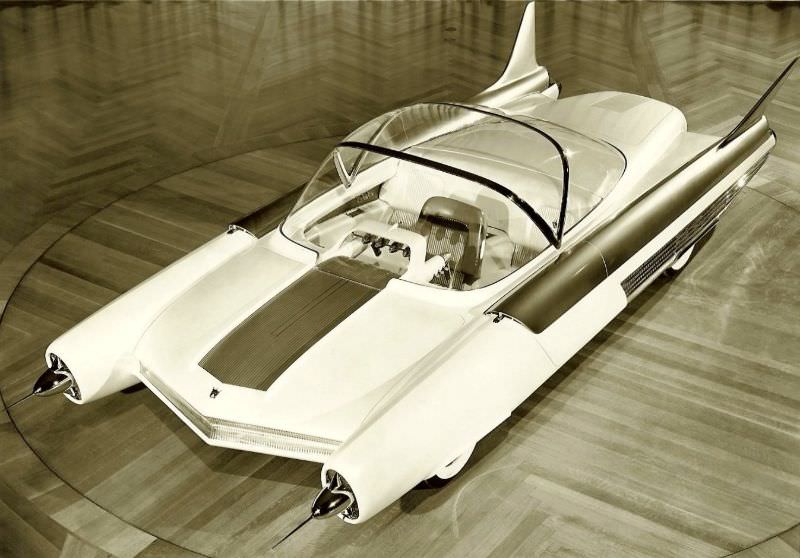
A sweeping canopy of glass crowns the 1954 Ford FX-Atmos concept, turning the passenger compartment into a cockpit and the whole car into a rolling daydream of the Jet Age. From this high angle, the body reads like a streamlined aircraft fuselage—long, low, and sculpted—with the kind of clean, optimistic curves that mid-century designers used to sell tomorrow. Even without a street scene or showroom signs, the polished presentation and dramatic lighting underline its role as a visionary “what if” rather than everyday transportation.
Along the flanks, dramatic tail fins and smooth side pods push the silhouette toward rocket-ship territory, echoing the era’s fascination with speed, science, and spaceflight. The nose is pointed and tidy, while the rear treatment—often described as rocket exhaust-style taillights—leans into the fantasy of propulsion and power. Details like the twin-seat layout visible beneath the dome suggest a showpiece meant to spark imagination, where form and spectacle take precedence over practicality.
Design experiments like the Ford FX-Atmos helped shape the visual language that would soon spill into mainstream automotive styling, from canopied dashboards to ever-bolder rear fins. For collectors, historians, and car-design fans, this historical photo is a window into 1950s concept car culture and the marketing of innovation—an “Inventions” story told in chrome, fiberglass, and glass. If you’re searching for futuristic concept car history, classic Ford prototypes, or the roots of rocket-age automotive design, this image captures that ambition in a single, unforgettable profile.