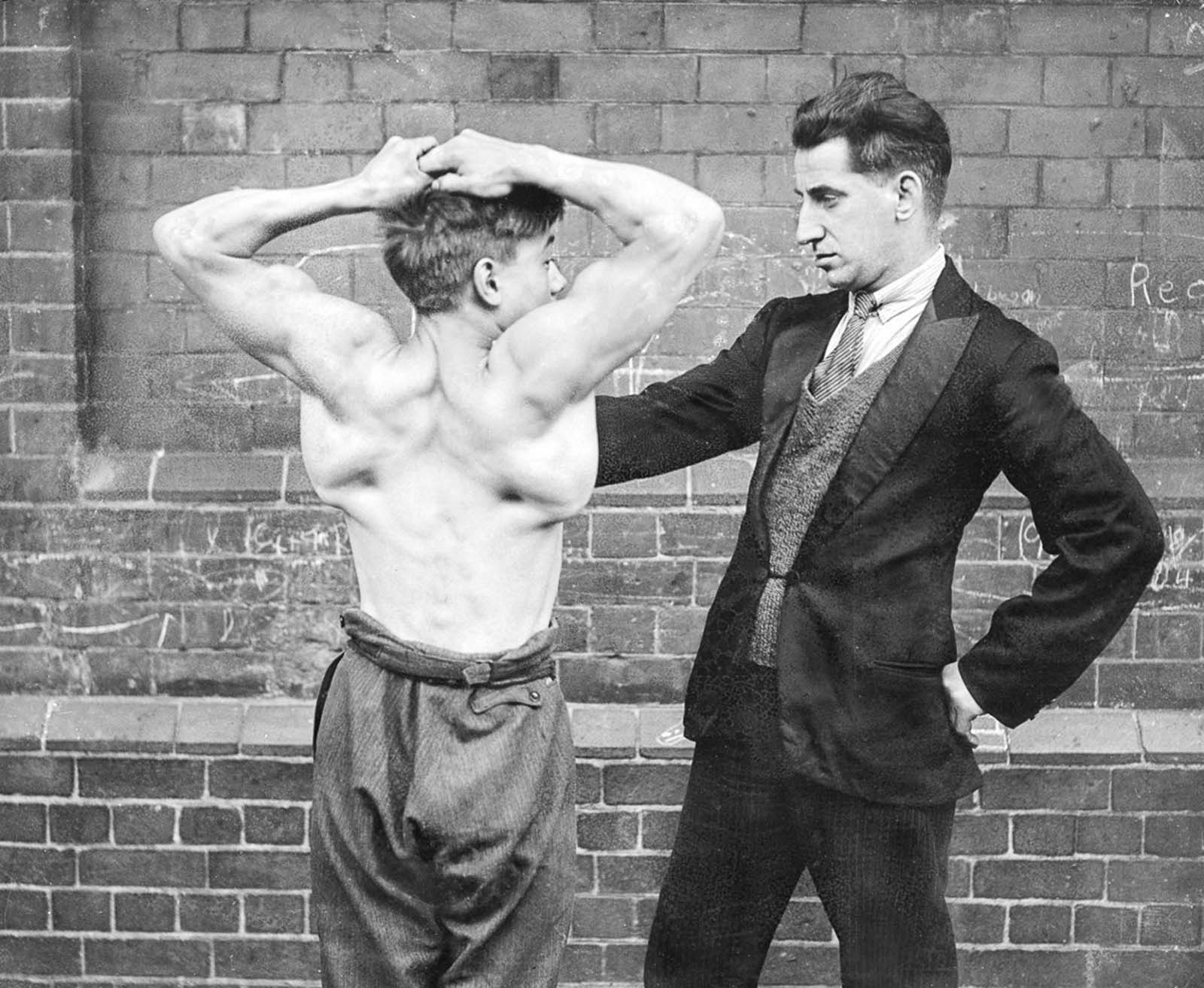
Arms raised and hands clasped behind his head, Lewis Clark—billed as “the strong boy”—strikes a classic bodybuilding pose that puts every ridge of his back on display. The bare torso contrasts with his high-waisted trousers, a practical, stage-ready look that belonged to the early twentieth-century world of physical culture. Behind him, a brick wall scuffed with chalky marks gives the scene a street-level realism that makes the feat feel immediate rather than theatrical.
Beside the young strongman stands a sharply dressed man in suit and tie, watching with a measured expression and one hand set at his hip. Whether coach, handler, promoter, or simply an onlooker, his presence adds a sense of evaluation—muscle not just shown, but inspected. The pairing underscores a familiar tension in strength history: raw athletic display on one side, and the social world that framed, judged, and marketed it on the other.
Dated 1930 in the title, the photograph offers a vivid glimpse into the era when strongmen and “boy wonders” were celebrated as proof of discipline, health, and modern vitality. Clark’s pose echoes the influence of vaudeville stages, gymnasiums, and newspaper features that helped popularize strength training long before today’s fitness culture. For readers searching vintage strongman photos, early bodybuilding history, or 1930s sports imagery, this striking moment captures both the spectacle and the seriousness of an age obsessed with impressive physiques.