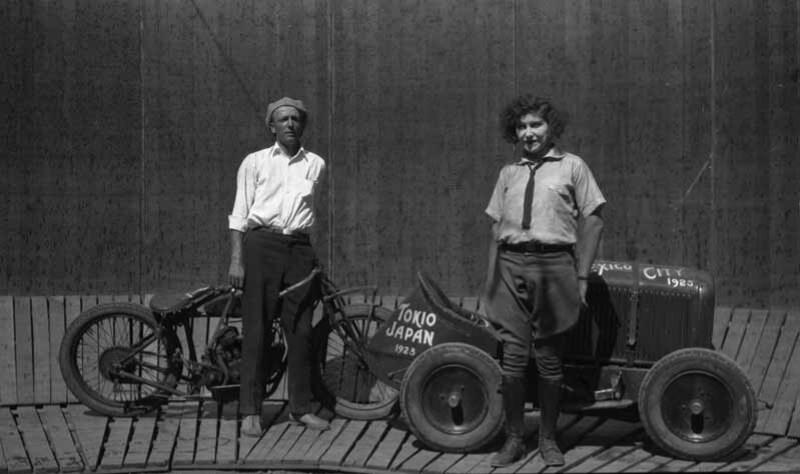
Lillian La France stands in work clothes and riding gear before a tall plank wall, the kind of arena surface built for speed, noise, and spectacle. Beside her sits a low, compact stunt car with hand-painted lettering on its body, while a motorcycle and another figure linger at the edge of the frame, hinting at the wider troupe behind the act. The straightforward pose feels deliberate: a calm moment taken on the boards before engines roar to life.
The photo’s details speak to 1930s sports entertainment and the daring culture of motorcycle stunt riding, when performers toured with “wall of death” and motordrome shows to prove what machines—and riders—could do. Hand-lettered signage and practical clothing suggest a traveling, do-it-yourself world where reputation was earned in front of paying crowds rather than on polished podiums. Even without motion, the wooden decking and close quarters convey the risk of tight turns, hard landings, and constant improvisation.
For readers searching for early women in motorsport, Lillian La France’s story offers a powerful glimpse into a field where courage mattered more than convention. The image functions as both historical record and invitation: look closely at the equipment, the setting, and the posture of a professional who made danger her craft. As a piece of 1930s motorcycle history, it highlights the grit and showmanship that helped shape stunt riding into the legend it became.