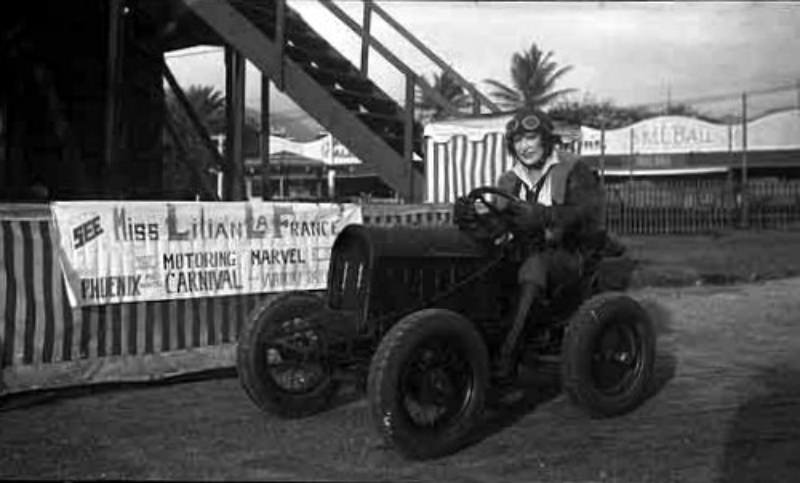
Leather cap pulled low and goggles at the ready, Lillian La France sits confidently behind the wheel as if the roar of engines were as ordinary as a Sunday drive. A banner along the fence calls out “Miss Lillian La France,” tying the scene to the carnival-style motor shows that drew crowds in the 1930s, when speed and spectacle were sold as modern thrills. The setting feels like a fairground arena—packed dirt under the tires, temporary railings, and grandstand structures hovering in the background.
What makes the moment striking is how matter-of-fact her presence appears in a field that was overwhelmingly marketed as a man’s domain. The sturdy, open vehicle and its oversized tires hint at stunt work built on control, balance, and nerve, not just raw horsepower. For readers interested in women in motorsports history, La France’s name on the signage reads like a deliberate announcement: she isn’t a novelty hidden in the program, but a featured attraction.
Beyond the details of clothing and machinery, the photo evokes an era when traveling shows and speed exhibitions were a gateway into popular sports culture. It’s a reminder that early motorcycle and motor-stunt entertainment relied on personalities as much as mechanics, and that performers like Lillian La France helped expand what audiences believed women could do on a track. As a historical snapshot of 1930s sports and daredevil performance, it invites a closer look at the overlooked pioneers who made noise, took risks, and claimed the spotlight.