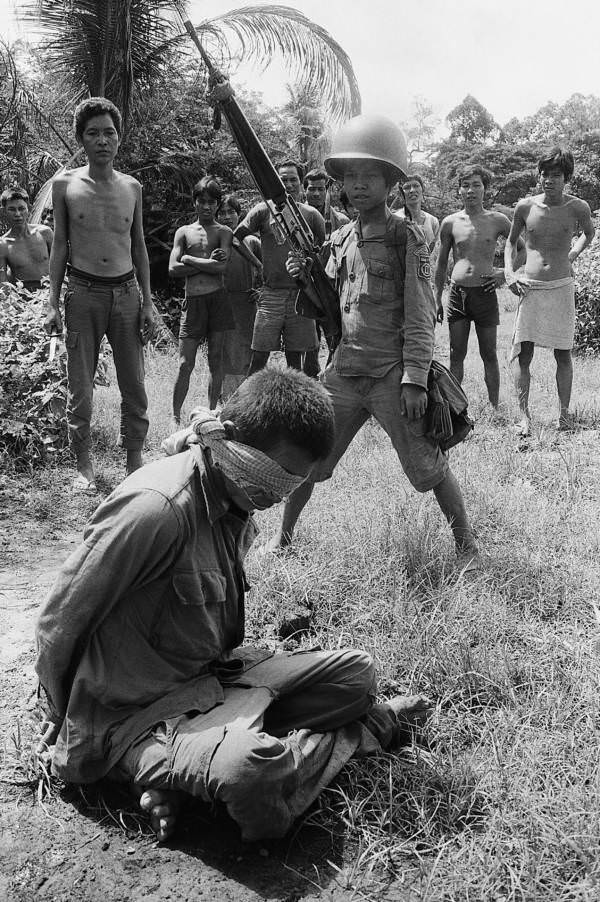
Under the hard light of rural Cambodia, a child in a military uniform and helmet stands with a rifle held upright, his small frame made stark by the weapon’s length. In the foreground, a blindfolded soldier sits on the ground with hands bound behind his back, shoulders slumped and head lowered in a posture of resignation. Around them, several young men—many bare-chested, some with arms crossed—form a loose ring in the grass, watching in tense silence beneath palm fronds and scrub.
The scene, titled from Angkor Chey and dated 1973, points to the brutal logic of civil wars where boundaries between combatant and civilian, adult and child, collapse under pressure. The boy’s stance reads as practiced authority, while the captive’s blindfold turns him into a symbol of vulnerability rather than an individual with agency. Faces in the background add another layer: witnesses who may be companions, local militia, or bystanders drawn into the moment, their attention fixed on what could happen next.
For readers searching for Cambodian Civil War photography, child soldiers, and conflict-era documentary images, this photograph confronts the human cost with unsettling clarity. It doesn’t rely on spectacle; instead, it records the everyday textures—dusty clothing, trampled grass, and the close proximity of onlookers—that make violence feel immediate and intimate. Seen today, it serves as a reminder that the history of Cambodia in the early 1970s was written not only in capitals and battle reports, but also in quiet clearings where fear, power, and youth intersected.