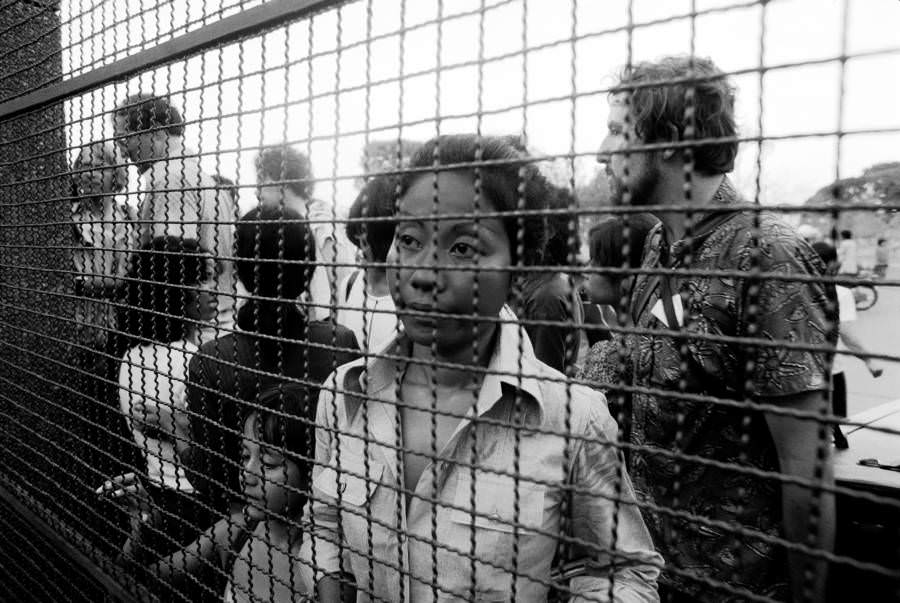
Pressed up against a welded wire gate, refugees search for any sign that the French Embassy in Phnom Penh might open to them in 1975. Faces appear and vanish behind the grid as bodies cluster in a tight corridor of uncertainty, the barrier turning every glance into a plea. A woman in the foreground looks straight through the mesh, her expression worn and watchful, while others behind her lean in, scan the street, and wait.
The gate does more than mark a property line; it becomes the sharp boundary between danger and the hope of sanctuary. In the tangle of overlapping figures—adults, children, and exhausted onlookers—the photograph conveys the crush of a city in crisis, where diplomacy and survival collide at a single entrance. The closeness of the crowd and the hard geometry of the fencing amplify a sense of confinement, as if the moment itself has been trapped.
Civil war is often summarized with maps and headlines, yet this scene insists on the human scale of upheaval: the split-second decisions, the fear of being turned away, and the fragile promise of protection behind embassy walls. For readers searching Phnom Penh 1975, Cambodian refugees, or French Embassy history, the image offers a stark visual record of displacement at the end of an era. It asks us to linger on what the gate hides as much as what it reveals—especially the lives waiting on the other side of international procedure.