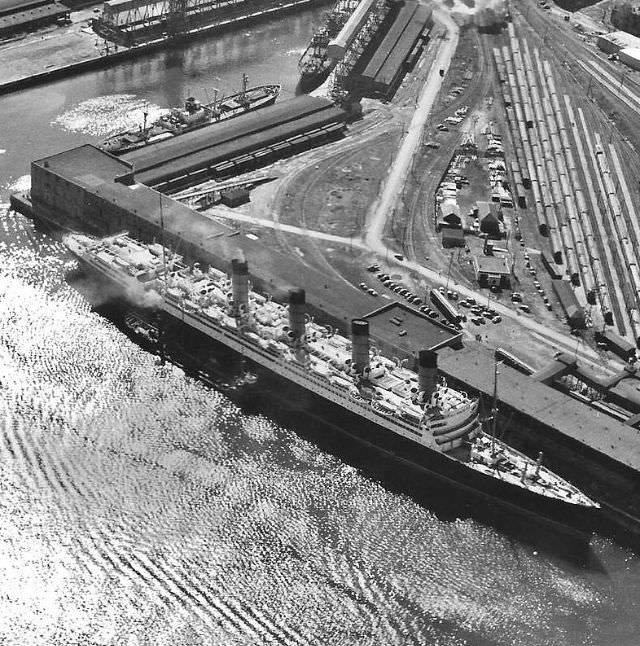
Moored along Halifax’s Pier 21 in the summer of 1949, the RMS Aquitania stretches across the frame like a floating city, its long hull aligned neatly with the wharf. From this elevated viewpoint, the ship’s multiple funnels and crowded decks stand out against the glittering harbour water, which catches the light in bright, rippled streaks. The angle emphasizes scale: the liner dwarfs the dockside structures and gives an immediate sense of how dominant transatlantic ships could feel when they arrived in port.
Across the pier, the working waterfront comes into focus—warehouse roofs, service roads, and a web of rail lines fanning out behind the terminal. Cars cluster near the buildings, hinting at the steady rhythm of arrivals and departures that defined this gateway. Even without close-up faces, the photograph conveys movement and purpose, capturing the infrastructure that supported ocean travel and passenger processing at one of Canada’s most storied immigration and travel hubs.
Seen today, Aquitania at Pier 21 reads as a snapshot of postwar transition, when traditional ocean liners still carried prestige while ports modernized around them. The industrial geometry of tracks and sheds contrasts with the ship’s streamlined elegance, underscoring how travel, commerce, and technology met on this stretch of Halifax Harbour. For readers searching for Halifax Pier 21 history or Aquitania in 1949, the scene offers a vivid, search-friendly glimpse of maritime Canada at mid-century.