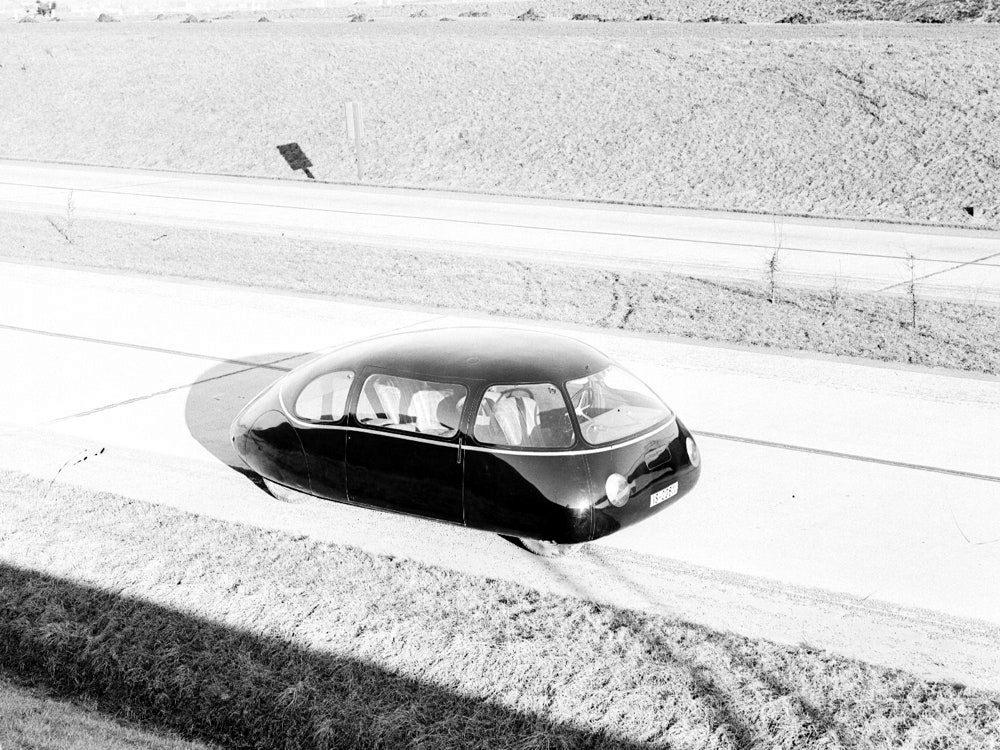
Few experimental cars look as otherworldly as the 1939 Schlörwagen, a bulbous “teardrop” machine that seems to have rolled out of a wind tunnel rather than a design studio. In the photo, its smooth, continuous bodywork swallows the wheels and stretches into a rounded tail, while a band of windows curves around the cabin like a visor. Even parked on an ordinary roadway, the silhouette reads less like a traditional automobile and more like an aerodynamic study made real.
That unusual profile wasn’t styling for its own sake—it was a bold attempt to tame air resistance at a time when most vehicles still wore upright grilles and sharp edges. The Schlörwagen’s domed roofline, narrowed rear, and enclosed sides point to a single obsession: reducing drag to improve efficiency and speed with limited power. Details visible here, from the compact stance to the near-seamless panels, underline the era’s fascination with streamlining and the belief that the future of motoring could be engineered through airflow.
Yet this ultra-aerodynamic German car never became a common sight, and its legacy survives largely through photographs and the stories they invite. Looking closely at this rare image, you can sense both the ambition and the compromise—an invention pushing beyond convention, but too strange, too specialized, or too impractical for widespread production. For readers interested in automotive history, pre-war engineering, and forgotten inventions, the Schlörwagen remains a compelling reminder that progress often travels down imaginative dead ends before the world catches up.